Coin vs Google Wallet: security improvements over plastic (part III)

Having looked at how Coin and Google Wallet use different approaches to presenting a wallet experience that can utilize multiple credit cards, this post looks at how they compare against traditional plastic cards in security. Specifically we focus on two common threats both technologies face:

  • Theft/loss of card. This also includes temporary access to the card by the adversary, such as settling a bill at a restaurant when the server gets full access briefly. (Although NFC payments are not typically used in this setting, we can extrapolate to the equivalent hypothetical scenario when the phone is  tapped against a hostile point-of-sale terminal.)
  • Data-breach occurring at a merchant where the card is used, or upstream at the payment processor used by the merchant. Target breach past October and the more recent PF Chang’s breach are examples of the first scenario, while the 2012 attack against Global Payments falls into the latter category.

Theft or loss of device

While Coin is not released yet, from the FAQ and a demonstration video one can surmise two features:

  • The magnetic stripe does not carry card information at all times. It is only visible during transaction time, limiting the window of exposure. If bad guys get hold the card outside that window, there is nothing to read out of the stripe directly. (Contrast this with traditional plastic cards, where the information can be read at any time.)
  • Physical proximity to the phone is required. The card locks up when it is out of range, measured by Bluetooth signal-strength. A corollary is that theft of the card alone is not useful directly, unless the thief also managed to get hold of the phone.

There is a caveat associated with both of these mitigations: they rely on the tamper-resistance of the hardware powering Coin. After all the track-data is still present inside the card, lurking somewhere on persistent storage; it is just not reflected on the dynamic stripe. If an attacker can extract this information by targeting the storage, they could obtain track data for all stored cards. Similar to the problem of extracting the cryptographic keys embedded in a chip & PIN card, this is an attack against the physical tamper-resistance of the hardware. At the moment little is known about the hardware inside Coin. There are standard benchmarks for evaluating the physical security of cryptographic hardware, such as the United States government’s FIPS 140-2 standard and its European counterpart Common Criteria. Popular models of smart-cards often boast a FIPS 140 or CC certification level, and EMV payment applications typically require such a certification before the hardware can be used to implement payment protocols. It is unclear if similar requirements will apply to Coin.

For Google Wallet, the main defense against theft is a PIN. Tap-and-pay is only possible when the application was unlocked “recently” by entering the correct PIN, based on a configurable time interval. In earlier incarnations of the product that leveraged the embedded secure-element, this period defaulted to 5 minutes. More recent versions based on host-card emulation extend that to 24 hours. That means if the user made a transaction recently the device is “armed” and ready for future purchases, by simply turning on the screen. Even unlocking the phone itself– such as by entering a pattern or PIN– is not required. Payments only require that the display is on, which is used as the signal to power-on the NFC controller.

Tamper-resistance used to be an important part of the threat model for earlier versions of Google Wallet, since  long-lived cryptographic keys were stored on the embedded secure element. Physical attacks against the SE could result in the extraction of these keys, allowing “cloning” of the card. (Unlike Coin however, SE hardware has proven track record and pedigree: both NXP SmartMX and Oberthur/ST33 family have underwent Common Criteria evaluation.) But later iterations of Wallet dropped support for SE in favor of NFC host card emulation, managing payment credentials on the main Android application processor. While there is no pretense of tamper-resistance on that platform, HCE also changes the key management model for payments. Instead of trying to secure a single key over an extended period of time, new keys are periodically downloaded from the cloud on-demand, after authenticating the user. This also serves as a useful mitigating factor against theft of the device. Even sophisticated attackers who can extract the secrets associated with an Android application will not be able to create a functional replica.

Skimming and compromised merchants

Google Wallet fares better than Coin against skimming and hostile point-of-sale terminals. Recall that while Coin card can suppress any data from appearing on the magnetic stripe until the moment of transaction, when that swipe does eventually happen, the data surrendered to the reader will be an identical clone of one of the user’s existing cards. Coin FAQ admits as much:

” A Coin is no less susceptible than your current cards to other forms of skimming that capture data encoded in the magnetic stripe as the card is swiped.”

By contrast NFC payments produce a “simulated” track-data with two components that change for each purchase: an incrementing transaction counter and a dynamic card-validation-code or CVC3 computed jointly by the reader and wallet application in a challenge-response protocol. In other words the track-data is constantly changing, unlike the static picture presented by Coin to every cash register. Even if an attacker commands a malicious NFC terminal and observes several different CVC3 values, they can not recreate future CVC3 values necessary to successfully authorize a different transaction. (More details about the construction of the simulated mag-stripe appear in earlier posts about a hypothetical scenario: paying with NFC at Target when the retailer was still under attack– hypothetical because Target has not rolled out NFC.)

Even more importantly, the virtual card used by Google Wallet to redirect payments is completely decoupled from the “real” plastic cards the consumer added to their wallet as funding sources. Nothing about the original cards– not the cardholder name, expiration date or even the types of cards Visa/MC/AmEx/Discover present in the wallet– can be inferred from use of the virtual card. This in itself is very useful when recovering from a breach: even if merchant terminals had been completely compromised a la Target, there is no need to cancel and reissue the physical credit cards of customers who paid with Google Wallet. The only “card” at risk is the virtual one issued by Google for proxying transactions, and it is Google’s problem to reissue that card– which is as easy as provisioning a new one over the air to the phone. Banks who issued the “real,” tangible cards safely hidden on the other side of those transactions need not worry about shipping new pieces of plastic to their customers.

CP
Host-card emulation and interop with multiple NFC wallets

Can multiple NFC tap-and-pay applications coexist on the same phone? The premise may sound overly ambitious, considering that getting even a single wallet to work has been a challenge during this nascent period of mobile payments. Until recently Google Wallet was only available on Sprint and unlocked T-Mobile/AT&T devices, while the ISIS project from US wireless carriers depends on switching to a special SIM card.

This quagmire was caused less by any inherent limitation in technology and more  by strategic maneuvering on the part of wireless carriers and OEMs to control payments. Both the embedded secure element originally used by Google Wallet and the new UICC hardware required for ISIS support the presence of multiple applications, in accord with Global Platform specifications. In principle that permits multiple wallets to co-exist on the same hardware, but the catch is secure elements are locked down platforms. Users can not install their own choice of applications. Special privileges typically obtained via contractual arrangements with the entity controlling the chip are required. Such deals have not materialized at large-scale.

Host-card emulation offers one way out of the quagmire by removing dependency on the secure element. Payment applications no longer require a secure element– only NFC controller– being able to install new apps on that dedicated SE or special privileges for interfacing with SE from an Android application. Does this solve the problem of multiple wallets? That depends on the definition of what it means for multiple wallets to coexist on the same device.

Detour: NFC transactions

Before diving into why having multiple wallets coexisting is still a challenge, here is quick primer on how EMV protocol operates. Starting from the moment the customer brings their device into the induction field of the NFC reader:

  • Terminal detects the presence of an NFC type-4 tag, or what Android calls ISO-Dep type.
  • A connection is set-up for exchanging messages called APDU or Application Protocol Data Unit.
  • Terminal activates the PPSE (Proximity Payment System Environment) application by sending an APDU containing a SELECT command with the well-known AID for PPSE.
  • Terminal interacts with PPSE to get a list of payment instruments available on the “card” (which in this case is actually a phone operating in NFC card-emulation mode) Each instrument is represented by a unique AID, in order of user preference. For example if the user prefers to pay with their Discover and use Visa as fallback in case that is not honored by the merchant, PPSE would present 2 AIDs with the Discover application appearing first.
  • Based on user preferences and merchant capabilities, one of these options is chosen by the terminal.
  • The terminal SELECTs the chosen payment application by AID and executes the network-specific protocol, such as PayPass for MasterCard or payWave for Visa.

One wallet at a time

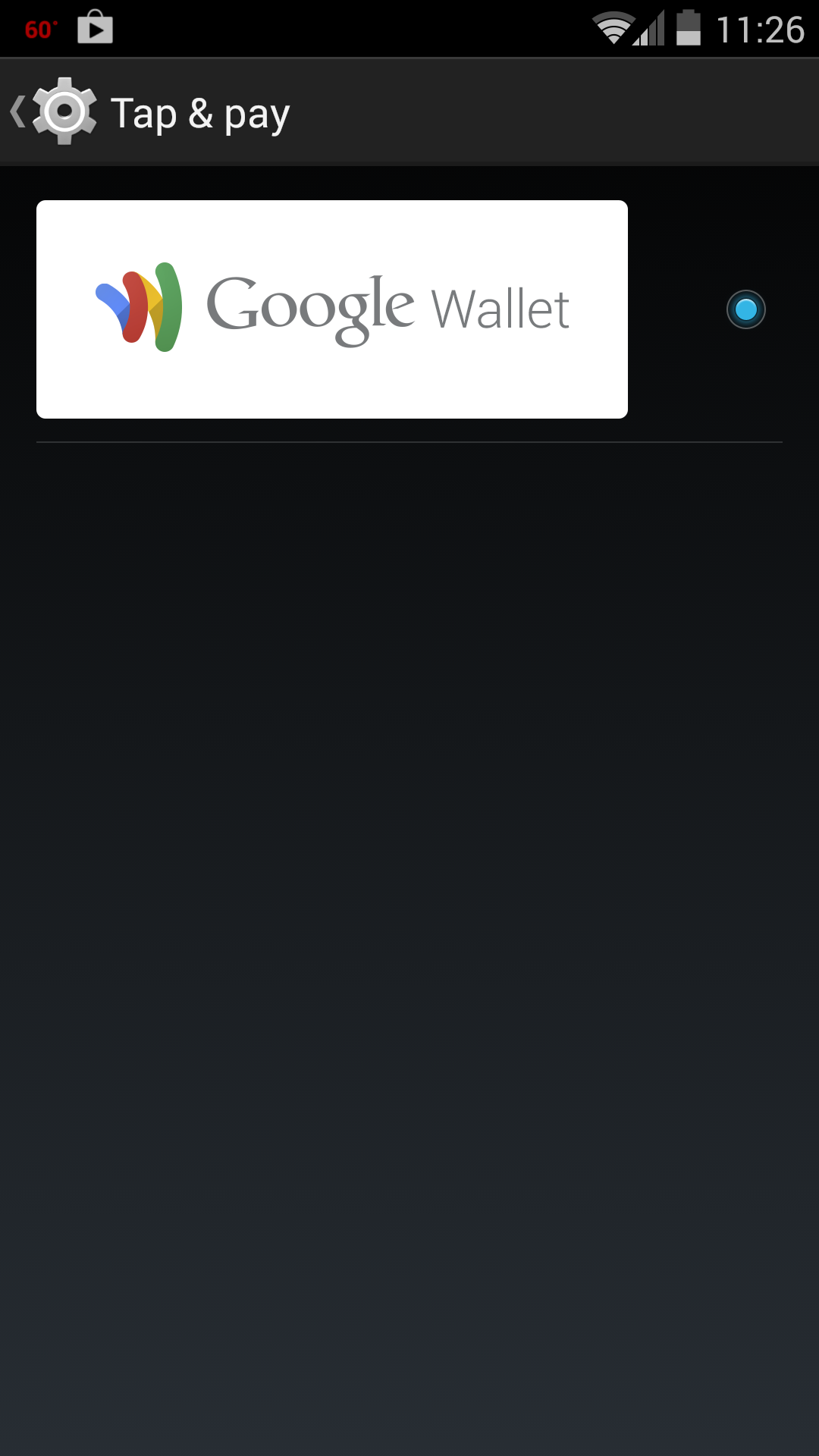
Screenshot from Android 4.4 showing tap & pay settings

Tap & Pay settings from Kitkat

Designating  a single application for payments is straightforward: Android settings features a dedicated view to pick between available options. Under the hood, that setting controls routing for a specific AID: the one reserved for PPSE. The expectation is that each mobile wallet capable of handling NFC payments will declare that it can handle PPSE and other AID prefixes associated with different networks (for example A0000004 for MasterCard)

There is one subtlety: the syntax used for declaring HCE services permits the application to define groups such that either all or none of the AIDs in that group will be routed to the application. This avoids the situation when PPSE and cards get out of sync. Consider two wallet applications each containing a MasterCard. If the user decides to activate the first one, all future PPSE traffic will be routed there. But if the AID prefix for MasterCard remains associated with wallet #2, an inconsistent transaction state will arise. PPSE emulated by wallet #1 is used to pick a card for payment, but the actual payment is handled by wallet #2, contrary to user preference.

Multiple active wallets

While the scenario for a single NFC payment application is handled gracefully, the same approach does not work for combining multiple cards  from different wallets.

The problem is the directory view presented by PPSE. Because PPSE is routed to one specific wallet, at any point only the payment options associated with that application are available for NFC payments. Each wallet application maintains its own directory of cards, blissfully unaware of other wallets installed on the same device.  Using another card associated with a different mobile payment application requires changing the PPSE routing.

There is no system-wide PPSE instance to aggregate cards from multiple payment applications and create a unified representation to the point-of-sale terminal, containing all the payment options available to that customer. (Strictly speaking, it does not have to be an OS feature. In principle payment apps could agree on a standard among themselves to use Android intents for communicating card information to each other. But this assumes products from competing providers will cooperate for the higher-cause of serving the user, and possibly to their own detriment when a competitor’s payment option is prioritized above their own. This is asking a bit too much, which is why such functionality is best centralized in the core operating system.)

CP

Coin vs Google Wallet: comparing card-aggregation designs (part II)

[continued from part I]

Google Wallet: one more level of indirection

“All problems in computer science can be solved by another level of indirection.” — attributed to computer science pioneer David Wheeler

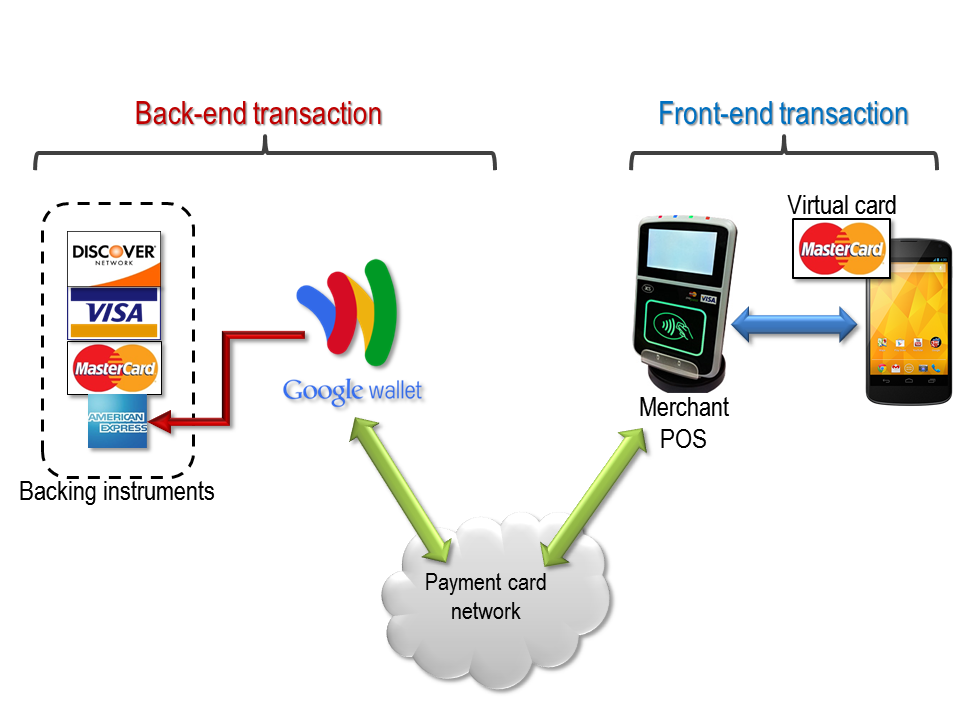
Google takes a very different approach to supporting multiple cards in a mobile wallet. Instead of carrying a literal representation of all the payment instruments, they are all hidden behind a “virtual card” which can effectively redirect transactions to any of these original credit cards. But this routing is done in real-time via the payment network itself, instead of trying to recreate a bitwise clone of the card.

Google Wallet: using virtual cards to proxy transactions

Google Wallet and virtual cards

Virtual cards

The picture above illustrates how this works, in the context of mobile payments using an Android phone over NFC. (Note that Google also launched an ordinary plastic card in 2013 which has slightly different functionality. In this example we cover the better-known NFC payment scenario where the existence of the virtual card is less obvious.)

Users have one or more backing instruments or funding sources in their wallet. These are standard credit cards, “added” to the conceptual wallet once by entering card-number and other relevant details such as expiration and CVC2 on a web-page or the mobile application, much like one would enter credit-card information when making an online purchase. This step is the rough equivalent of the swipe-magnetic-stripe/photograph/confirm sequence used by Coin when adding cards.  At any given time, exactly one of these backing instruments is active, which is to say the transactions will be charged to the card. Also much like Coin, the Google Wallet mobile app has UI for selecting among the options.

Proxying transactions in real-time

Where the two models diverge despite superficial similarities in UI metaphors is what happens during a transaction. When Google Wallet is used for an in-store NFC purchase, the credit-card seen by the point-of-sale terminal is not any of the actual backing instruments. Instead it is a virtual card, unique to that instance of Google Wallet. Each user and even each instance of the wallet application associated with a given user has its own virtual card provisioned. In one sense, this card is very “real:” it is a full-fledged MasterCard effectively issued on behalf of Google, accepted at any NFC terminal that supports the MasterCard PayPass protocol. It has an ordinary 16-digit card-number with a prefix associated with the MasterCard network, an expiration date and for NFC transactions, cryptographic keys used to generate the dynamic CVC. It is only “virtual” in the sense that its existence is not explicitly surfaced. For example, nowhere in the mobile app are the card-number or other details about this card revealed to the user, although one can often spot the last 4 digits printed on paper receipts. (In principle a determined user could simulate the NFC transaction with their own reader to observe the card-number, since this is part of simulated track-data exchanged in the clear as part of PayPass.) Consequently it is never directly handled by the end-user– never entered into a form on a web-page or recited over the phone. Nor does it ever appear on a consumer credit report as an additional card; much like a prepaid card would not show up as a line of credit.

When a user makes an NFC transaction with Google Wallet, the payment network– MasterCard in this case– will route the authorization request to Google, the nominal issuer of the virtual card. Google will in turn place a payment request on the active backing card for the exact same amount. Pending the outcome of that authorization, the original “front-end” transaction is approved or declined. All of this is done in real-time, and must complete in a matter of seconds to comply with network rules around transaction deadlines.

Two transactions in one

There are interesting consequences to this design. First is that Google plays dual roles:

  • Issuer: As far as the merchant is concerned, Google is the issuer for the card the customer just used. (Nominally Google partners with Bancorp Bank for this purpose, with Bancorp ending up as the issuer of record, as described in the Wallet FAQ entry.)
  • Merchant: As far as the original issuer of the backing card is concerned, Google is a merchant requesting payment authorization from that card.

Second observation is that virtual-card and actual backing instruments are completely decoupled. Unlike in the case of Coin, the Google Wallet virtual card is not a perfect replica of the original card the user added to their wallet. It does not have the same expiration date. They do not share the same name: for NFC transactions, cardholder names–ordinarily part of the emulated track data– are redacted. In fact they may not even be on the same network: the virtual cards are MasterCard but the active funding source could be a Discover or American Express card. This is the illusion created by the virtual card: as far as the customer is concerned, they just paid with their American Express card– even if the merchant does not actually accept AmEx cards, a common situation at small businesses. The merchant on the other hand may be slightly better off in terms of transaction fees. Even if they were accepting AmEx, they will likely pay a lower transaction fee for processing the same amount over MasterCard network, compared to ringing up a “native” AmEx card.

Another interesting property: the transaction types are different. The merchant side experience is a card-present (CP) payment– this is how all NFC tap-payments are treated, no different from swiping the magnetic stripe. Meanwhile the original issuing bank for the backing instrument sees a card-not-present (CNP) transaction from Google, similar to what would happen when making a purchase online by typing card details into a web page. In effect the CP transaction at the point-of-sale was proxied in real-time into a CNP transaction against the backing card.

Other twists are introduced by this two-sided design, such as the handling of disputes and charge-backs, as well as handling merchant-specific rewards such as a credit-card that gives cash-back for purchases made only at gas stations. For our purposes, the key architecture difference between cloning cards (Coin) and proxying transactions in real-time to another card (Google Wallet**) is sufficient to explore questions around how each technology holds up against common fraud-vectors, as well as their future prospects in the face of EMV chip & PIN adoption.

[continued]

CP

** Historical side-note: the first version of Google Wallet in late 2011 did not use virtual cards. Instead users had the option of provisioning their existing Citibank MasterCard or requesting a new prepaid card, also on the MasterCard network. Both of these were “native” cards: transactions were routed directly to the issuer without Google in the loop. From an implementation perspective, each card was represented by a distinct applet on the Android secure element. Virtual cards were introduced in an update the following August, and native cards subsequently deprecated.

Coin vs Google Wallet: comparing card-aggregation designs (part I)

Judging by the excitement around crowd-funded Coin, “card-aggregation”– having a single credit-card that can stand-in for multiple payment instruments– speaks to an unmet market demand. In the abstract the concept hardly seems innovative and already implemented in various online approximations. Many online  services such as PayPal perform exactly this service in the context of web payments. Users can load their PayPal account from traditional debit/credit cards or ACH transfers from a checking account, and later get to spend the funds at any merchant accepting PayPal. But that model requires a change on the merchant side to integrate the new payment method; PayPal transactions look very different from standard credit or debit payments to the merchant. Also customers typically fund a stored-balance account ahead of time, floating money to the payment provider and committing to the payment source long before the actual transaction time. It is a lot more tricky to support real-time card aggregation in the context of existing card networks and even more difficult to implement that for in-person payments at a bricks-and-mortar location as opposed to online transactions. (Prepaid cards suffer from the same problems as PayPal: requirement for advance funding.)

Coin is not the first company to tackle this problem but it has gotten a lot more traction than previous attempts which for the most part, never went beyond a technology demonstration. One possible exception is Google Wallet. In 2012 Google introduced a different approach for combining multiple payment credit-cards in a single mobile wallet. [Full-disclosure: this blogger worked on Google Wallet.] These two products make for an interesting comparison, attempting to create the same user-experience with diametrically opposed designs under-the-hood.

Coin: commercializing the dynamic mag-stripe

Coin is an example of the programmable magnetic-stripe (also called “dynamic magnetic stripe”) technology, covered earlier on this blog. When credit cards are swiped, the point-of-sale terminal reads information encoded on a thin-film made of magnetized material on the back of the card. That information is used to request payment authorization from the card network. The physical layout as well as logical format for this is standardized by ISO/IEC 7813. Informally the format is often referred to as track-data, because it is organized into three tracks with only the first two used on payment cards.

For vanilla plastic cards the contents of the magnetic stripe never change. They are written once at the time of issuance and remain fixed for the lifetime of the payment instrument. About the only change that can occur is unintended and detrimental: when the card comes into contact with a very strong magnetic field, that can lead to erasure of encoded data, resulting in an unreadable card much to the chagrin of the cardholder. This basic technology remained unchanged for decades, until around 2010 when programmable magnetic stripes made their commercial debut. These use a small embedded processor on the card to change the encoded data on demand. It’s clear this technology allows the realization of many advanced concepts, such as single-use card numbers or even single-use track data for a fixed card number that would be immune against skimming. (One could even implement a variation on the mag-stripe profile of EMV, by simulating an internal counter and reader-challenge to output track data containing  dynamic CVC3.)

Coin implements a more elementary scenario: switching between track-data copied from multiple cards, in order to “simulate” any one of these cards. Coin relies on what is arguably a security flaw in the design of magnetic-stripe cards: it is trivial to clone them. Information encoded on the stripe is fixed and readable by anyone in possession of inexpensive off-the-shelf equipment. Anyone can create a new card with exactly the same data– and consequently the same spending authority as the original card, when it is swiped for a purchase.

Abstract architecture of Coin

Coin card model for aggregating multiple cards

Card-cloning, grassroots approach

When journalists speak of card-skimming attacks against ATMs and point-of-sale terminals, usually they are referring to gangs installing malicious software or physically tampering with reader hardware to steal magnetic-stripe data for any card swiped at that location. Armed with that information, the criminals can create duplicate cards bearing same track-data and attempt fraudulent purchases with these clones. (There are additional complications of course: the cards need additional features to look legitimate, such as appropriate logos, holograms, embossed card-holder name etc. Also CVC2 is not present on the magnetic stripe, as such the “clone” is only usable for card-present transactions.)

Coin institutionalizes that practice, except this time cloning is done by the cardholder for his/her own convenience/benefit.

The product has not been released to the general public at the time of writing, but extensive FAQs and a lengthy demonstration given to TechCrunch conveys the general approach taken for provisioning. Users are given card readers– similar to the ubiquitous white Square readers– that interface with their iPhone/Adroid device. Existing plastic cards are swiped to extract their track-data. A mobile app then syncs the information over Bluetooth to the Coin card where it is stored. Shortly before a transaction, that same mobile app allows choosing among cloned cards. Dynamic magnetic-stripe is then reconfigured to present a perfect copy of the same track-data as found on the original card.

[continued at part II]

CP