[Full disclosure: This blogger is not an attorney and what follows is not legal advice.]
Unsolicited gifts on chain
In the aftermath of the OFAC sanctions against Tornado Cash, it has become an article faith in the cryptocurrency community that banning blockchain addresses sets a dangerous precedent. Some have argued that blacklisting Tornado addresses and everyone who interacts with them will have dangerous downstream effects due to the interconnectedness of networks. Funds flow from one address to another, the argument goes, often merging with unrelated pools of capital before being split off again. Once we decide one pool of funds are tainted by virtue of being associated with a bad actor or event—a scam, rug-pull or garden-variety theft—that association propagates unchecked and continues to taint funds belonging to innocent bystanders who were not in any way involved with the original crime. As if to illustrate the point, shortly after the ban imposed on US residents from interacting with the Tornado mixer, some wisecrack decided to use that very mixer to send unsolicited funds to prominent blockchain addresses. These were either addresses with unusually high balances (eg “whales” in industry parlance) or previously tagged as belonging to celebrities or well-known cryptocurrency businesses such as exchanges. Here is an unsolicited “donation” sent to the Kraken cold-wallet through the Tornado mixer.
That raises the question: are these unwitting recipients also in violation of OFAC sanctions? Are all funds in those wallets now permanently tainted because of an inbound transaction, a transaction they neither asked for or had any realistic means to prevent given the way blockchains operate? With a few exceptions, anyone can send funds from their own address to any other address on most blockchains; the recipient cannot prevent this. Granted, there are a few special cases where the recipient can limit unwanted transfers. For example, Algorand requires the recipient to opt-in to supporting a specific ASA before they can receive assets of that type. But that does not in any way prevent free transfer of the native currency ALGO. Ethereum smart-contracts make it possible to take action on incoming transfers and reject them based on sender identity. Of course, this assumes the recipients have a way to identify “bad” addresses. Often such labels are introduced after the offending address has been active and transacting. Even if there was a 100% reliable way to flag and reject tainted transfers, requiring that would place an undue burden on every blockchain participant to implement expensive measures (including the use of smart-contracts and integrating with live data feeds of currently sanctioned addresses, according to all possible regulators around the world) to defend against a hypothetical scenario that few will encounter.
Given that inbound transfers from blacklisted addresses can not be prevented in any realistic setup, does that mean blacklisting Tornado Cash also incidentally blacklists all of these downstream recipients by association? While compelling on its face, this logic ignores the complexity of how distributed ledgers track balances and adopts one possible convention among many plausible ones for deciding how to track illicit funds in motion. This blog post will argue that there are equally valid conventions that make it easier to isolate funds associated with illicit activity and prevent this type of uncontrolled propagation of “taint” through the network. To make this case, we will start with the simple scenario where tainted funds are clearly isolated from legitimate financial activity and then work our way up to more complex situations where commingling of funds requires choosing a specific convention for separation.
Easy case: simple Bitcoin transactions
UTXO model
The Bitcoin network makes it easy to separate different pools of money within an address, because the blockchain organizes funds into distinct lumps of assets called “unspent transaction outputs” or UTXO. The concept “balance of address” does not exist natively in the Bitcoin ledger; it is a synthetic metric created by aggregating UTXO that all share the same destination address.
Conceptually, one can speculate if this was a consequence of the relentless focus on privacy Satoshi advocated. The Bitcoin whitepaper warns about the dangers of address reuse, urging participants to only use each address once. In this extreme model, it does not make sense to track balances over time, since each address only appears twice on the blockchain. First when funds are deposited at that address, temporarily creating a non-zero balance. The second and last reference occurs when funds are withdrawn, after which point the balance will always be zero. This is not how most bitcoin wallets operate in reality. Address reuse is common and often necessary for improving operational controls around funds movement. Address whitelisting is a very common security feature used to restrict transfers to known, previously defined trusted destinations. That model can only scale if each participant has a handful of fixed blockchain addresses such that all counterparties interacting with that person can record those entries in their whitelist of “safe” destinations.
For these reasons it is convenient to speak of an address “balance” as a single figure and draw charts depicting how that number varies over time. But it is important to remember that single number is a synthetic creation representing an aggregate over discrete, individual UTXOs. In fact the same balance may behave differently depending on the organization of its spend candidates. Consider these two addresses:
- First one is comprised of a thousand UTXOs each worth 0.00001 BTC
- Second one is a single 0.01 BTC UTXO.
On paper, both addresses have a balance of “0.01 bitcoin.” In reality, the second address is far useful for commercial activity. Recall that each bitcoin transaction pays a mining fee proportional to the size of the transaction in bytes—not proportional to the value transacted, as most payment networks operate. Inputs typically account for the bulk of transaction size due to the presence of cryptographic signatures, even after accounting for the artificial discount introduced by segregated witness. That means scrounging together dozens of inputs is less efficient than using a single output to supply a given amount. In the extreme case of “dust outputs,” the mining fees required to include a UTXO as input may exceed the amount of funds that input contributes. Including the UTXO would effectively be a net negative. Such a UTXO is economically unusable unless network fees decline.
Isolating tainted funds
This organization of funds into such distinct lumps makes it easy to isolate unsolicited contributions. Every UTXO stands on its own. If funds are sent from a sanctioned actor, the result is a distinct UTXO that stands apart on the bitcoin ledger from all the other UTXOs sharing the recipient address. That UTXO should be considered tainted in its entirety, subject to asset freeze/seizure or whatever remedy the powers-that-be deem appropriate for the situation. Everything else is completely free of taint.
One way to implement this is for the wallet software to exclude such UTXOs when calculating available balances or picking available UTXOs to prepare a new outbound transaction. The wallet owner effectively acts as if that UTXO did not exist This model extends naturally to downstream transfers. If the tainted UTXO is used as input into another subsequent bitcoin transaction (perhaps because the wallet owner did not know it was tainted) it will end up creating another tainted UTXO while leaving everything else untouched.
Mixed bag: transactions with mismatched inputs/outputs
The previous section glossed over an important aspect of bitcoin transactions: they can have multiple inputs and outputs. The more general case is illustrated by transaction C here:
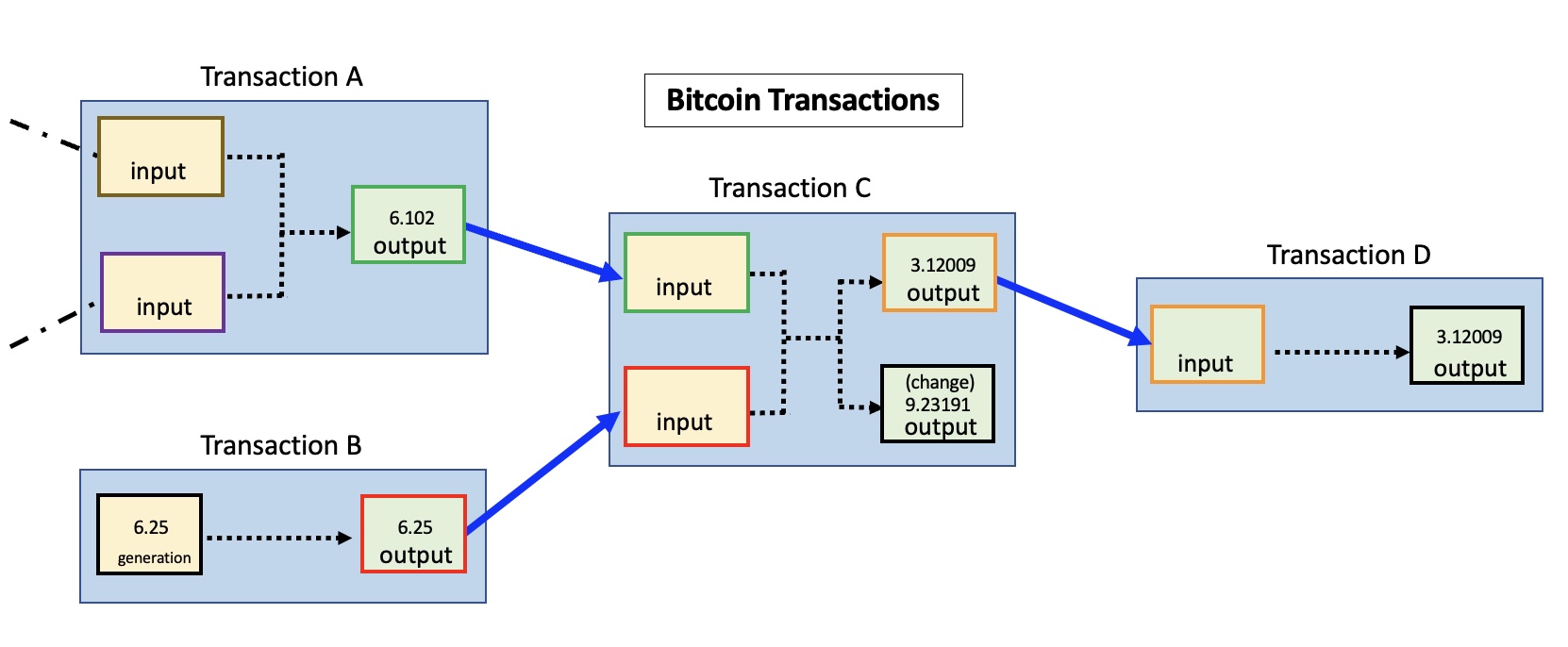
Consider an example along the lines of transaction C, but using a different arrangement of inputs and outputs:
Inputs:
- First input of clean 5 BTC
- Second one worth 1 BTC originating from a sanctioned address
Outputs:
- First output is designated to receive 3 BTC
- Second output receives 2.999BTC (leaving 0.001 BTC in mining fees)
Due to the different amounts, there is no way to map inputs/outputs in one-to-one relationship. There is a total of 1 tainted bitcoin on the input side that must be somehow passed through to outputs. (There is of course the question of where the mining fees came from. It would be convenient to argue that those were paid for using tainted funds to reduce the total. But here we will make the worst-case assumption: tainted funds must be propagated 100% to outputs. Mining fees are assumed to come out of the “clean” portion of inputs.)
A problem of convention
Clearly there are different ways taint can be allocated among the outputs within those constraints. Here are some examples:
- Allocate evenly, with 50% assigned to each output. This will result in partial taint of both outputs.
- Allocate 100% to the first output. That output is now partially tainted while the remaining output is clean. (More generally, we may need to allocate to multiple outputs until the entire tainted input is fully accounted for. If the first input of 5BTC had been the one from a sanctioned address, it would have required both outputs to fully cover the amount.)
- Same as #2 but select the tainted outputs in a different order. The adjectives “first” and “second” are in reference to the transaction layout on blockchain, where inputs and outputs are strictly ordered. But for the purposes of tracking tainted funds, we do not have to follow the same order. Here are some other reasonable criteria:
- FIFO or first-in-first-out. Match inputs and outputs in order. In this case since the first output can be paid out of the first clean input entirely, it is considered clean. But the second output requires the additional tainted 1 BTC so it is partially tainted.
- Highest balance first. To reduce the number of tainted outputs, use the outputs in decreasing order until the tainted input is fully consumed.
Regardless of which convention is adopted, one conclusion stands: No matter how one slices and dices the outputs, there are scenarios where some UTXO will be partially tainted, even if the starting state follows the all-or-none characterization. Previous remedies to quarantine or otherwise exclude that UTXO in its entirety from usable assets are no longer appropriate.
Instead of trying to solve for this special case in bitcoin, we look at how the comparable situation arises in Ethereum, which differs from Bitcoin in a crucial way: it does not have the concept of UTXO. Here the concept of “balance” is native to the blockchain and associated with every address. That means the neat separation of funds into discrete “clean” and “tainted” chunks cannot possibly work in Ethereum, forcing us to confront this problem of commingled funds in a broader context.
CP
 Random Oracle